I have several automated alerts set up on eBay that notify me daily of new auction items such as surveying equipment, historically significant maps, compasses and pocket transits. While I buy very sparingly off of eBay these days, I find these alerts useful for tracking price trends on different classes of items. Normally the direction is up, but on some things like sextants the prices have held steady and even dropped a bit over the years. This reflects a ‘glut’ of instruments coming out of the Indian sub-continent as large vessels are sold to salvagers in the region and the buyers find these instruments on board during the stripping process before the ships are moved to the breaker yards.
Pocket transit offerings on eBay over the past year or so have been somewhat ho-hum. We’ve seen a flood of inexpensive Chinese knock-offs hit the market, a number of full-price retailers using eBay as a secondary sales channel, a few folks who think dad’s old Brunton should contribute significantly to their 401k and price the starting bid accordingly, a couple of really nice instruments from K&E (in my opinion these were as well made as the the original Ainsworth transits). Other than that its been mostly common instruments from Ainsworth and Brunton.
This morning I got a notification for a new auction on an Ainsworth pocket transit and the the opening bid price grabbed my attention – a whopping $2,300. I immediately clicked over to eBay to see what was on offer.
Someone is selling a very early Ainsworth pocket transit (serial # 198) attributed to an R. E. Palmer, a mining engineer for the Rio Tinto Mine group. Evidently Palmer and David Brunton were associates and at one point Palmer hired Brunton to consult on a project at the original Rio Tinto mine site in Spain.

The seller provides a bit of information on the original owner.

So we have a well established tie-in between David Brunton and R. E. Palmer, but did Brunton personally give this pocket transit to Palmer? We will never know for sure, and the provenance for this item is not well established in the auction listing. But it is fun to speculate.
Overall this transit appears to be in very good condition.
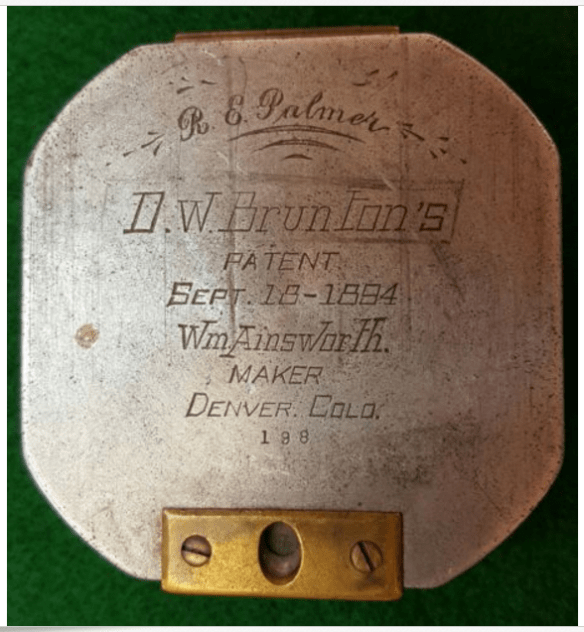
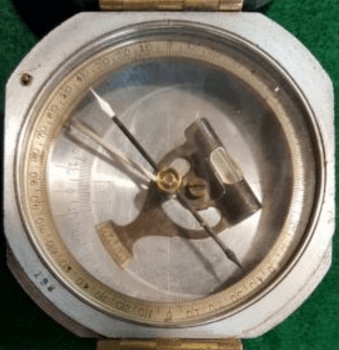
However, it’s clear to me this pocket transit is not in original condition. The needle is wrong for an instrument made this early. The original needle would have been the much simpler bar type as found on pocket transits produced up into the high 6000 serial number range. Does this indicate anything nefarious is going on with the auction? No, not at all. These instruments saw hard service in the hands of mining engineers, geologists, foresters and other field scientists and engineers . It was also common for the early steel needles to lose their magnetism over time (this was long before the development of permanent ‘rare earth’ magnets). Brunton designed the pocket transit to be repairable, and it’s highly likely that after years of honest use this instrument was sent it back to Ainsworth to have the needle replaced.
In addition to the needle I suspect the mirror is also a replacement. Most of the silver backed mirrors of this era show extreme levels of ‘foxing’ – a natural process that occurs over time. This mirror just looks too new. But again, this is not an unusual repair for a working instrument.
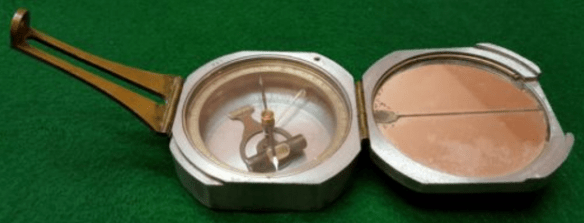
This is the second oldest pocket transit we’ve seen, by serial number. There’s only one other Brunton in the Pocket Transit database that has an earlier serial number – # 105.
We’ll keep an eye on the auction to see if it generates any bid activity. If any of my readers end up purchasing it or winning it at auction I’d love more information on it and perhaps some better pictures!
– Brian

 Northing & Easting