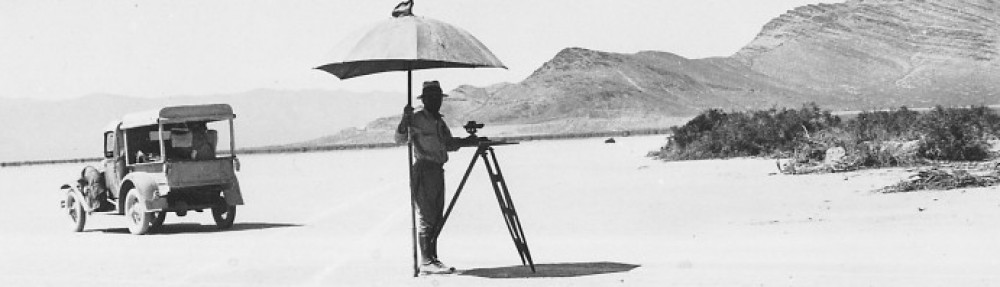
Map Makers At Work

I was going through some photos in my collection for some Facebook friends and ran across a collection of old shots I acquired while assigned to the 320th Engineer Company (Topographic) back in the late 1990s. I say ‘acquired’ because I just happened to find them lying around my office as part of some left over historical records from the old 649th Engineer Battalion (Topographic). All are 1970’s vintage photos that highlight the map making activities of the 649th. The 649th provided comprehensive topographic support – survey, map production & distribution, terrain analysis, and geographic intelligence analysis – to US Army Europe (USAREUR).

In the early 1980’s I was assigned to the 649th at Tompkins Barracks in Schwetizingen, Germany. I served as the commander of one of the terrain analysis detachments. I have a lot of good (and some not-so-good) memories of the 649th and the Soldiers that served in the unit. Fifteen years later I found myself back in Germany. By then the 649th had been deactivated and my unit, the 320th Engineer Company (Topographic), was the last surviving remnant of the 649th. The 320th had received a lot of left over equipment and paperwork from the 649th and one of my duties was to sort through it all to determine what was worth keeping and what could be trashed. During this process I found the photos you see in this post.

All of these photos were rejects, shots the photo editor didn’t think were worthy of using in a presentation. That accounts for a lot of the grease pencil ‘mark outs’ you see on many of the images. The interesting part is that the pictures that made it past the editor and into various publications or presentations are long gone – either packed up with the unit’s archives and locked away in an Army records warehouse or tossed into a trash can. Only the rejects survived to make it to my desk long after the battalion inactivated.

The 649th rarely made a new map from scratch. Most of the work involved updating existing maps or creating specialized overlays (like military operational graphics) to be overprinted onto existing maps. Still, the battalion had all the functional components necessary to create a new map:

  • Topographic and geodetic survey
  • Photomapping and cartography
  • Layout, photolithography and printing press operations

To accomplish these tasks each topographic company within the 649th was divided into three platoons – the Survey Platoon (topographic & geodetic survey), the Photomapping Platoon (photo control, compilation and drafting) and the Reproduction Platoon (layout, photolithography and press).

So let’s take a look at these processes as practiced by Soldiers of the 649th. This isn’t intended to be a comprehensive overview of map making; there are some large gaps in this tale simply because I don’t have any photos depicting specific steps. The real goal here is to highlight the Soldiers and their activities.


 Survey

Each map starts with two things – stereo aerial photography and a topographic survey to ‘tie’ the photos to their location on the face of the earth. Army topographic units relied on US Air Force photomapping squadrons to provide the aerial photography. Once the topographic unit got the aerial photography in hand it was up to the surveyors to go out and collect precise location data for points visible in the photographs – things like road intersections, prominent terrain features or pre-positioned survey point targets.

APPS

APPS – the Analytical Photogrammetric Positioning System. The APPS permitted surveyors and terrain analysts to precisely determine points on the ground using georeferenced stereo images. The system consisted of a point positioning stereoscope hooked to an early HP desktop computer. Each set of stereo images came with a computer tape that held the ephemeris data for each image. The operator would pick a point on the image in stereo (road intersection, building roof, etc.), tap a foot switch and the computer would print out the point location in latitude and longitude. The APPS was often used by surveyors to collect photo control point coordinates without having to do a formal field survey. For its time this was a revolutionary system.


Survey1

Surveyors ‘turning angles’ with a conventional theodolite (probably a Wild T2). The instrument would be set up over a known control point and used to measure the precise angle to other control points. The operator would call out the angle readings and the Soldier standing behind with the notebook would record the readings and do quick checks of the angle measurements to ensure the readings were accurate.
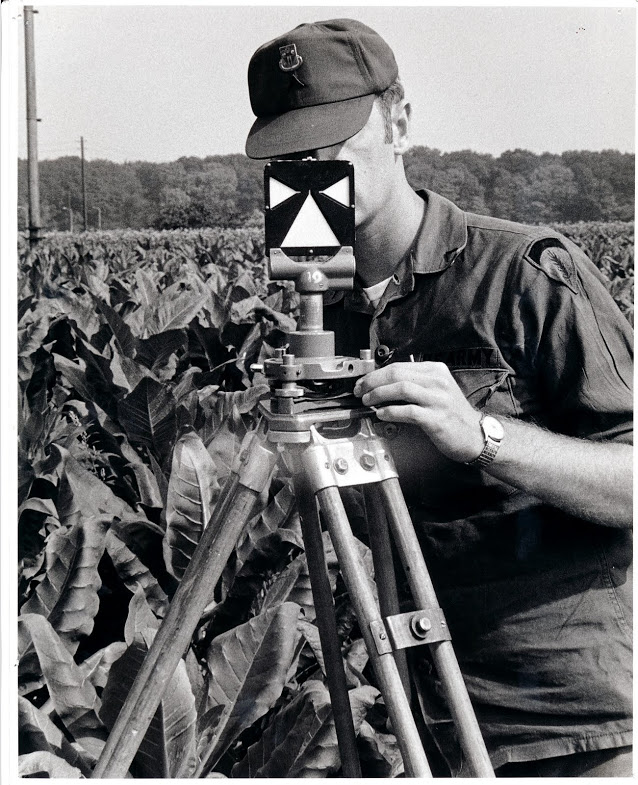
 

Survey4

What are the surveyors in the previous photo aiming at? One of these, of course! This is a Wild survey target. It would get set up over a control point that is key to the survey. The theodolite operator adjusts the crosshairs in the theodolite telescope so they bisect the white ‘arms’ and ‘skirt’, of the target, then reads the angle of measurement.
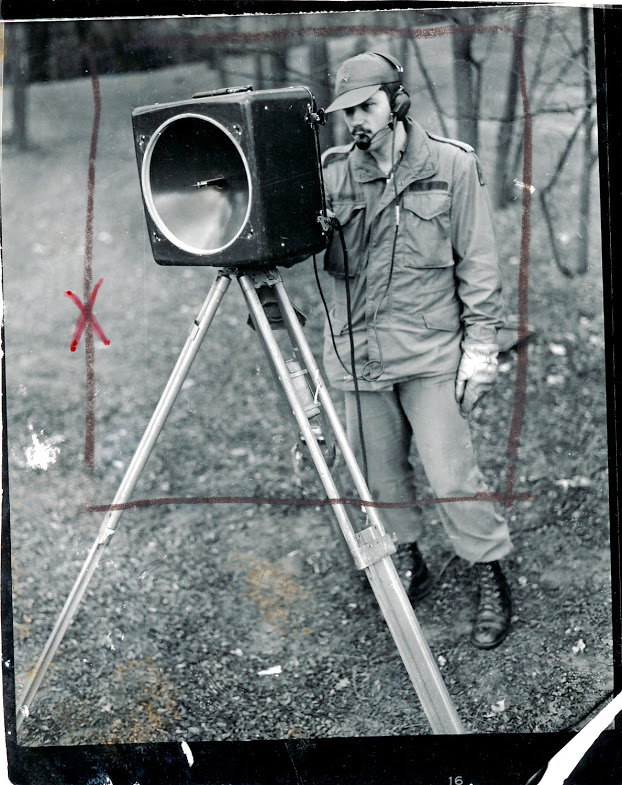
 

Survey2

 If a theodolite measures angles how do we measure distances? Well in the 1970’s we used microwave distance measuring equipment called the Tellurometer. The system consisted of a master and a remote unit and measured the time it takes a reflected microwave signal to return the master unit, which was then converted into distance. While I don’t have any hands-on experience using these units, I do remember sitting in on several meetings at the 649th where the surveyors discussed what a headache they were to operate and maintain. By 1980’s standards this was old technology and the units the Army had adopted were becoming maintenance nightmares. But in their time these distance measuring units were a revolutionary time saver. Note the headset the soldier is using. He’s actually talking to the operator at the remote unit via a built-in radio link. The two operators had to continuously coordinate settings and monitor performance during the distance measurement operation.


Survey3

 Here is the back of the Tellurometer unit showing the instrument settings panel.
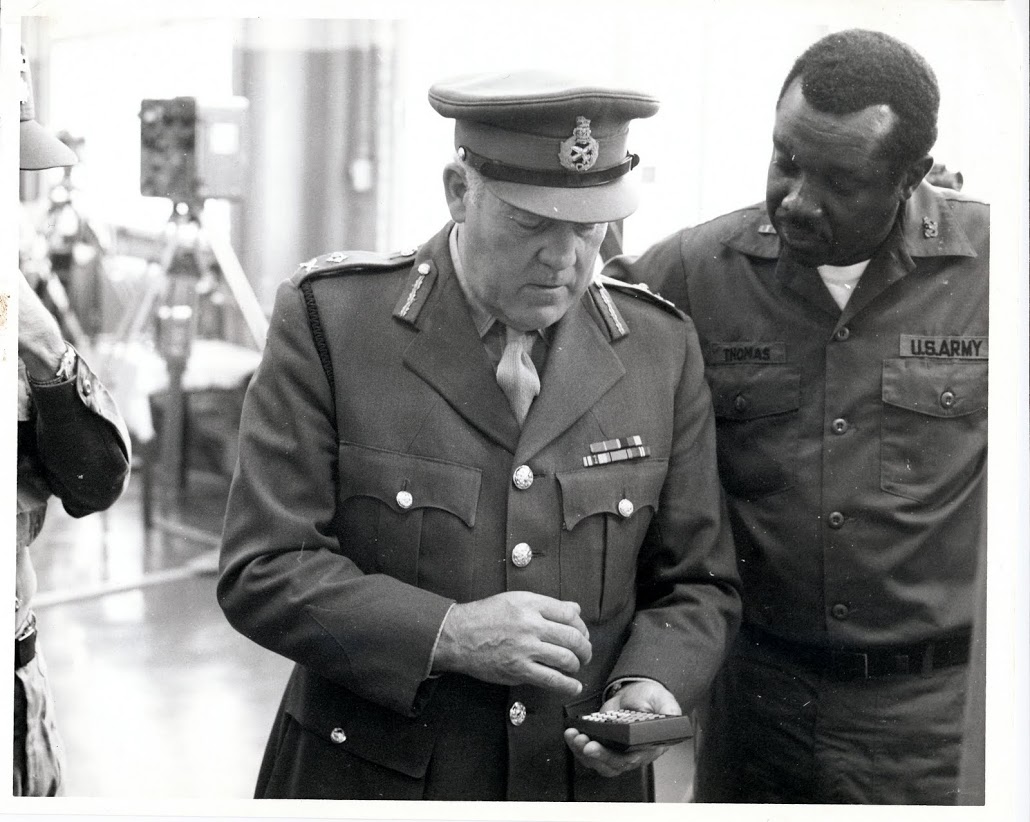
 

Calculator

This picture shows the only Soldier in this series that I’ve met. CW2 Thomas (on the right) is demonstrating a new Hewlett-Packard calculator to a visiting British Army officer. CW2 Thomas was one of several survey warrant officers assigned to the 649th. We met at Fort Bragg, North Carolina years after this photo was taken. The Hewlett-Packard (HP) calculator is interesting because they were widely adopted by surveyors due to their rugged construction and advanced functions that were well suited to surveying applications. While I don’t think any HP pocket calculator was ever officially adopted by the Army they were in wide use at the Defense Mapping School where our surveyors were trained. Many of the HP calculators found their way into survey units through local purchase by individual units.


 Photomapping

Photomapping is the process of compiling a topographic map based on information seen in the aerial photographs. Military topographic maps consisted of at least five distinct information layers, each with its own color – cultural features (black), water (blue), vegetation (green), contour lines (brown) and boundaries and built-up areas (red). It is the job of the cartographer to extract each of these information layers from the aerial photography to create a map manuscript. First the cartographers would rectify each aerial photo by removing any tip or tilt in the photo and tying it to the survey control points. Then they would use a device called a multiplex plotter to project the photos in 3D so the cartographer can trace out the key features while viewing the photos in stereo. Once the information is traced onto a manuscript sheet it is passed over to other cartographers who precisely trace out the collected information using the precise symbols we see on the finished map.

Carto3

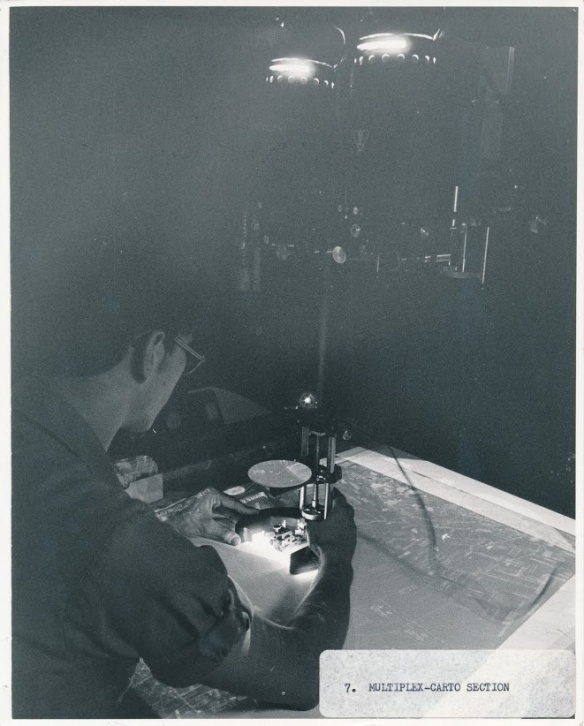
This photo shows a cartographer setting up a multiplex plotter in preparation for tracing out a new map information layer using photomapping techniques. The multiplex plotter used a stereo pair of aerial photos to project a 3-dimensional image of the terrain onto the white disc or platen of the mutiplex tracing ‘table’ (the device with the white disc seen sitting on the table). The tracing table has a small tracing dot engraved on it that sits directly above a pen holder. The stereo images have been transferred to two small glass diapositive images, and in this picture you see the cartographer holding one of the diapositives in his left hand as he mounts it into the projection stage. The tall ‘can’ in his right hand is the projector assembly that contains the projection lamp, lens assembly and filter. One diapositive is filtered red, the other blue, and the operator wears a pair of glasses with one red and one blue lens (just like the old-time 3D movie glasses), enabling him to see the projected image in stereo.
 

multiplex plotter

Here we see a cartographer tracing data from the projected image onto a manuscript sheet (usually a sheet of dimensionally stable material like Mylar). You can see entire image projected onto the the table surface just under his forearm, but only the small area projected onto the multiplex table platen is in focus. Engraved on the center of the platen is a small tracing ‘dot’, and mounted directly below it is a tracing pencil. The cartographer carefully adjusts the platen up or down so the tracing dot appears to rest directly on the ground on the stereo image and he then begins to trace out features. He traces one layer type onto each sheet; one sheet for cultural features, one sheet for hydrology (water), one sheet for vegetation etc.


Cartographer

Once a manuscript map layer is drawn it is turned over to other cartographers who carefully trace out the data using approved map symbols and line types. This is called the compilation process, where the cartographers compile the data into standard formats. Map compilation is precise and exacting work, and a cartographer can spend days, sometimes weeks, working on a single sheet.


Carto2

Once each manuscript layer is complete it the information it holds is photographically ‘burned’ or transferred to specially coated plastic called either scribe coat or peel coat (seen above). The words ‘scribe’ and ‘peel’ describe the manner in which the orange coating (seen above) is removed to create clear windows through which a photographic negative can be exposed. Because of the unique nature of the orange coating it completely blocks all the light wavelengths that a film negative is sensitive to, so the orange areas come out black (or unexposed) when the negative is processed. Cartographers use specially designed scribing tools to carefully etch away the areas that represent point or linear features like individual buildings or roads. For larger areas like lakes or farm fields a sheet of peel coat is used, which allows large areas to be carefully cut with a sharp knife or razor blade and peeled away.
 

Carto4

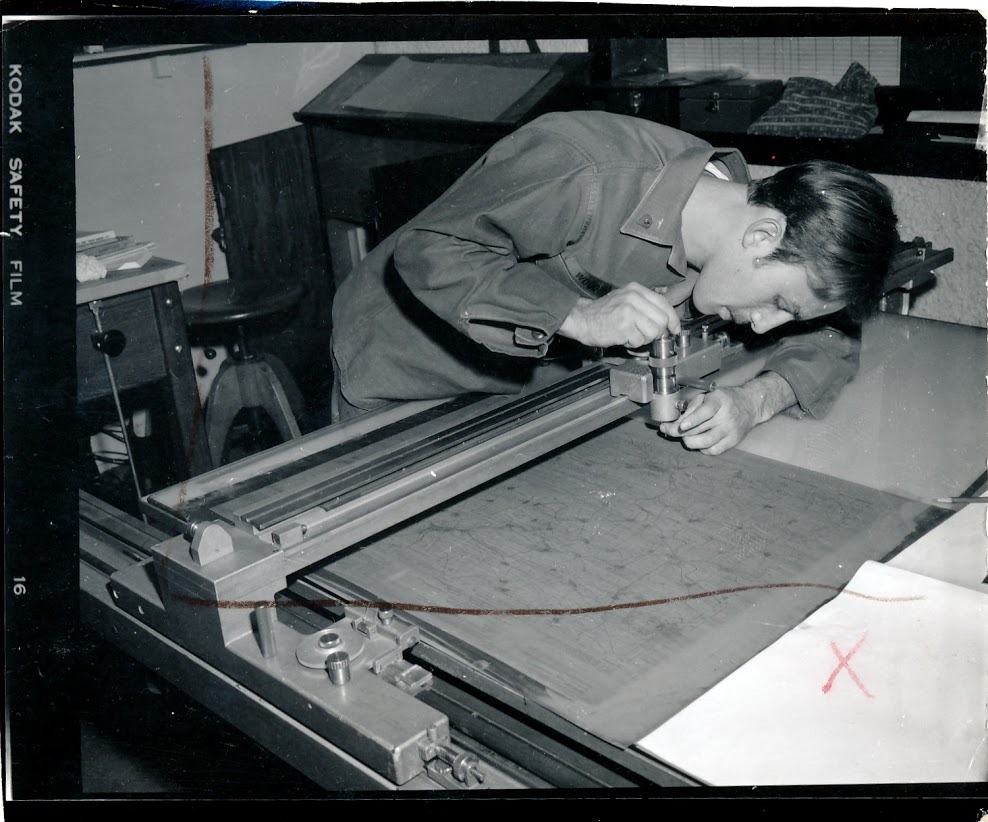
All military maps have grids, and the grid on each map is unique based on the area of the world it covers. Calculating and drawing these grids requires great precision and accuracy since the grids must be exact or the grid coordinates a Soldier derives from an improperly gridded map could be hundreds or thousands of meters off. Here a cartographer is setting up an automated plotting device used to precisely draw the grid for a particular map sheet. Automated tools like this greatly reduced the human error often encountered when drawing grids and speeded up map compilation.


Map Reproduction

Once the cartographers completed the map compilation phase the manuscript sheets were turned over to the Reproduction Platoon for all the steps necessary to print the final map. This normally involved preparing negatives from the scribe and peel coat layers prepared by the Photomapping Platoon, editing and correcting the negatives, making press plates and finally, printing the map.
Layout3

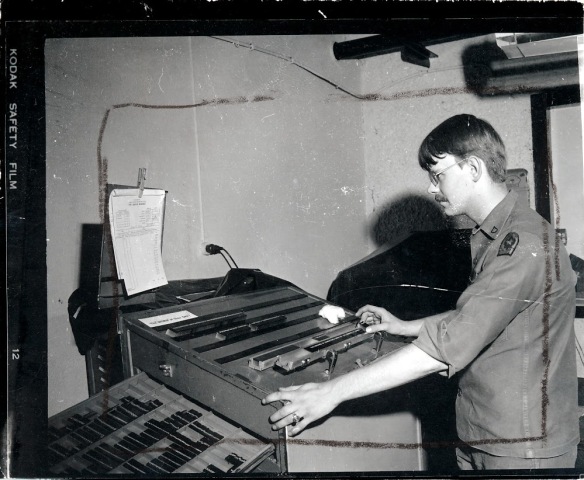
To speed up the map compilation process cartographers made heavy use of pre-printed text. Things like standard place names (cities, towns, etc.), major feature names (rivers, mountains, etc.) and road identification symbols (highways, autobahns, etc.) would all be identified using standarized text that was prepared by the Reproduction Platoon. The cartographer would submit a list of feature names with text style and size requirements and the Reproduction Platoon personnel would provide the information on clear adhesive backed sheets that were created using a photo transfer process. Here we see a Soldier setting up some text as requested on the order sheet attached to the clipboard.


Layout1

One of the last steps in map production is making the negatives from which the press plates are produced. Here we see a Soldier from the Reproduction Platoon doing a final check of a negative before approving it for plate production.


Layout2

The final step before going to press is the plate making or ‘burning’. Press plates are just thin sheets of aluminum specifically sized to fit on a printing press. A map layer negative representing all features of the same color (black, blue, green, brown or red) is placed on top of a press plate that has been coated with a photo sensitive emulsion and the two are placed in a vacuum frame plate maker that uses a high intensity lamp to ‘burn’ or expose the positive image onto the plate. Once the plate is burned it is washed to remove the emulsion and the resulting image is what gets printed on the map. In this photo we see a Soldier from the Reproduction Platoon doing a final cleaning of a press plate before sending it on to the press section.


Press3

The 649th ran a number of presses of different size and capacity, everything from small trailer mounted presses capable of producing only 1:50,000 and 1:250,000 scale maps to large format presses permanently installed in the battalion’s base plant and capable of producing over-sized maps and other geographic products. In this picture we see a press operator from the Reproduction Platoon loading a press plate onto a van mounted Harris offset press.


Press2

Here’s a photo of one of the 649th’s presses installed in its baseplant at Tompkins Barracks in Schwetzingen.
 

Press1

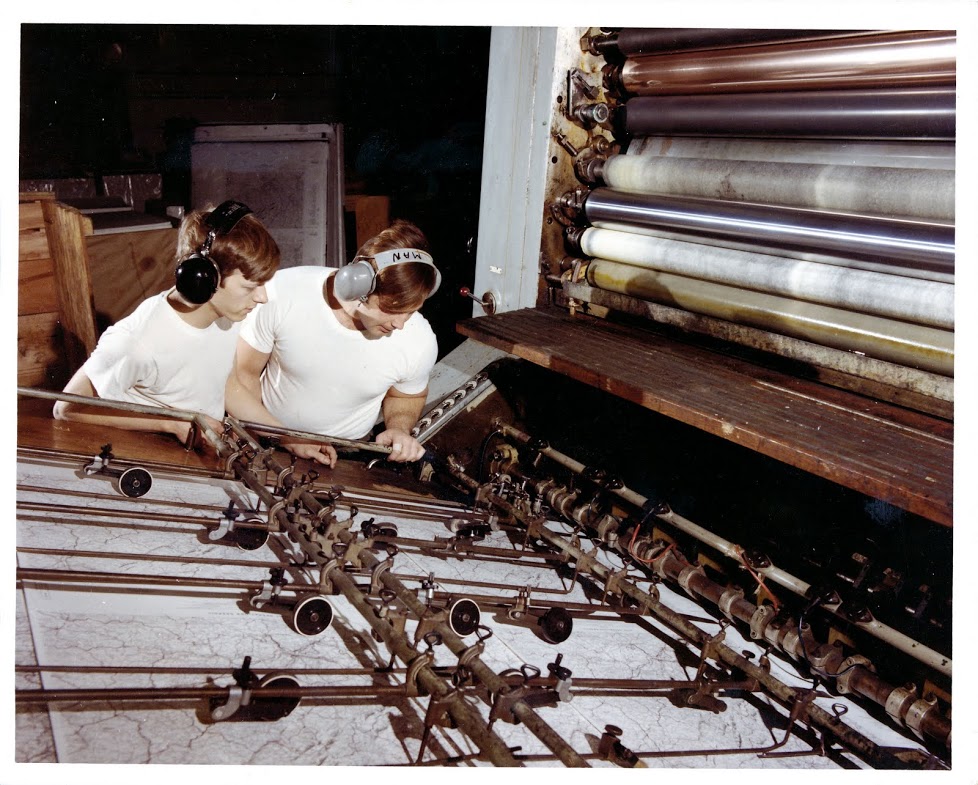
Here’s a photo of the feeder end of another one of the 649th’s large format presses. In this photo it looks like already printed map sheets are being fed back through the press to add another information layer or military overprint.


Map Distro

The very last step in map production is actually map distribution. The 649th also had a Map Distribution Platoon that stocked and distributed the printed maps to units all across Europe. The platoon was responsible for getting the most current maps into the hands of the front line soldier as quickly as possible. The 649th maintained a map distribution warehouse at Tompkins Barracks and at several contingency sites around Europe. The platoon even had specially designed vans that were mobile distribution warehouses that could service forward deployed headquarters. Here we see Soldiers from the Map Distribution Platoon restocking maps at the distribution warehouse at Tompkins Barracks.


And there you have it, Army field map production circa 1970. As I mentioned in the start of this post I’ve taken a lot of liberties by overly simplifying the map making process with the intent of highlighting the Soldiers and activities of the 649th. If any readers recognize any of the Soldiers shown in these photos (or if you happen to be one of these Soldiers) I’d love to hear from you. You can either add a comment to this post or contact me at oldtopographer(at)gmail.com. If I’ve made any factual errors in the map making process, or if I’ve mis-identified any of the process shown in these photos please leave a comment here and I’ll make the necessary corrections. Thanks, and I hope you’ve enjoyed this trip down memory lane!

– Brian

Oops

Word just came out that yesterday the Russians accidentally set eight of their GLONASS (the Russian equivalent of GPS) satellite statuses to ‘unhealthy’ for about half an hour. Setting a satellite status to ‘unhealthy’ means the satellite is programmed to tell receivers to ignore the navigation signals it is broadcasting because there’s something wrong with the satellite and the signals can’t be trusted. Eight satellites constitutes over half of the GLONASS operational constellation. When this many satellites are set to ‘unhealthy’ it means that most advanced GNSS receivers will simply ignore the entire system and not even try to use their signals to calculate a position.

glonass satellite

This is not good news for the Russians, or for GLONASS users world-wide. (Got a smartphone? Then you are a GLONASS user whether you realize it or not). For years the GLONASS program has been plagued by corruption, poor management, poor planning, lack of funding and launch failures. The GLONASS program’s biggest problem has been money, or a lack of it. Global satellite navigation systems are frightfully expensive and require long-term capitalization and national committment. Only the United States with its NAVSTAR GPS system has been successful in establishing and maintaining a healthy world-wide space-based satellite navigation system for over 20 years. In Russia’s defense, at least they’ve been able to get a fully operational system up and running. The European Union has been stumbling around with their Galileo system for 15 years and so far about all they’ve been able to do is put a few test satellites in orbit.

As they say on TV, “but wait, there’s more!”  Back on April 1st the entire GLONASS system went wonky when bad ephemeris data was uploaded to the satellites. Ephemeris data is what allows each satellite to accurately locate itself while in orbit. Ephemeris data is updated regularly for all satellites in a system – it’s part of the routine system maintenance process. Well someone uploaded bad ephemeris data files to the entire GLONASS constellation and for 11 hours every satellite in the system was squawking bad navigation data. The Russians didn’t realize it until one of their commercial customers called to tell them their satellites were providing lousy location fixes.

Oops.

Better keep those paper maps and magnetic compasses handy.

– Brian

Mapping the Assault!

OK now, everybody hum a few bars of the Barry Sadler song, Ballad of The Green Berets.

It’s the mid-1960s. The Vietnam war is still a ‘good’ war in the minds of most Americans. In 1961 President Kennedy had turned the spotlight on the US Army Special Forces, the Green Berets. When Kennedy found them they were an obscure group of soldiers operating out of Fort Bragg, North Carolina, led by officers who had worked closely with partisan groups during WWII and understood the value of conducting behind-the-lines operations to disrupt, demoralize and undermine an invading enemy’s operations. The Big Army brass didn’t much like them – they were independent, unorthodox, and perhaps worst of all they insisted on wearing those damned green berets. But they were having an impact, particularly in Southeast Asia where they were leading South Vietnamese and other native forces in surprisingly effective operations against the Viet Cong and other communist-inspired forces. The Big Army brass may not have liked these cocky Green Berets but there was no arguing they were having great success with their unorthodox methods and tactics.

Then in 1965 author Robin Moore published his best seller ‘The Green Berets‘, a semi-documentary novel of Special Forces operations in Vietnam. Moore had spent almost two years training and then deploying to Vietnam with a Special Forces unit so he was writing from the inside, with a special perspective on the unit, its men and its mission. (Significantly, Robin Moore is the first and, as far as I know, only civilian to attend and graduate from the US Army Airborne School at Fort Benning and earn his jump wings.) Moore’s book was an instant best seller. It pushed the Green Berets back into the spotlight and, this time, into popular culture. Suddenly America couldn’t get enough of the Green Berets. There were Green Beret magazine covers, comic books, toys, documentaries, songs and a John Wayne movie. And even trading cards. Yes, bubble gum trading cards!

Mapping the Assault In 1966 the Philadelphia Chewing Gum Corporation (P.C.G.C.) got the rights to use some US Army promotional photos on a series of trading cards about the Green Berets. There were 66 cards in the series (one card to a pack of gum to ensure brand loyalty and continued sales). The cards were typical Army stock photo stuff – Green Berets jumping out of airplanes, rappelling out of helicopters, training with machine guns, etc. All highly sanitized for mid-60’s pre-teen consumption. No blood, no gore, no torture (you know, the typical stuff a pre-teen sees today on prime-time television). I’m not sure how long the series ran, but I do remember seeing these cards for sale and buying a few myself while my family lived in New Jersey back in the 1960s.

Since this card is the only one of the set that deals with the use of maps I thought I’d toss it up here. It looks like the picture was taken during an exercise. The white tape pinned around the sleeves of some of the Special Forces soldiers indicates they are evaluators (‘white force’) for an exercise, and may be providing an overall exercise briefing to the two Green Beret soldiers standing on the right and staring intently at the map board. It must be raining outside, because these two visitors are wearing their wet weather jackets and they look damp.

The picture quality isn’t good enough to indicate what area the maps on the map board cover, but it’s a good bet that it’s somewhere around the Fort Bragg area. You can make out some geographic boundaries highlighted on the map board, and one has been named ‘Maple’ (or ‘Marie’) and the other ‘Woody’. Probably notional countries or regions created for use during the exercise. Based on the general patterns I see on the map board these are probably a series of Army Map Service 1:50,000 scale map sheets taped together to make one large, continuous coverage map.

There’s little else we can glean from the photo other than it’s cold (and wet) outside – many of the participants are wearing what look to be M-1951 field jackets. The overall setup has a familiar exercise control cell look about it, somewhat spartan with the field table and chair set before the map, a copy of the exercise order sitting on the table and some status boards and another map board hanging on the wall to the right. Been there, done that many, many times over.

I’m told by active duty soldiers that things haven’t really changed. Even in this era of unlimited bandwidth, live data feeds. advanced digital mapping and command and control software and high resolution large format displays there are still old-fashioned map boards that go up for every exercise ‘just in case’.

I guess the more things change the more they remain the same. Makes an old topographer smile.

– Brian

Surveying The Land

In 1785, the Congress of the Confederation passed the Land Ordnance of 1785 in an effort to sell lands acquired through treaty or were relinquished by individual states in return for other concessions. (Remember your history here – the Constitutional Convention didn’t meet until 1787, and before that the states operated under a loose confederation with a weak, barely functioning central government.) In 1785 the federal government was about broke, was facing crushing debt and needed to do something fast to generate cash. The only resource they had was land – lots of land. It was a happy coincidence that settlers needed land – lots of land. The growing nation was spilling over the Appalachians and into the the new regions of the ‘Northwest Territories’ – today’s Western Pennsylvania, Ohio, Indiana, Illinois, Michigan, Wisconsin and Minnesota. Most were squatters, occupying land they didn’t have title to. Heck, nobody had clear title to the land because it hadn’t been mapped, surveyed and divided into salable parcels or lots. Not even Congress clearly understood what they had.

This is where the Land Ordnance of 1785 came in. The Ordnance established the mechanism by which the land was to be surveyed and divided into logical parcels that made for easy identification and sale. Known as the Public Land Survey System (PLSS), it established the township & range survey system that started on the western bank of the Ohio River in 1785 and ended up extending all the way to the Pacific Ocean. In September 1785 surveyor Thomas Hutchins walked down to the bank of the Ohio River opposite Georgetown, Pennsylvania, drove a stake in the ground and established the origin point, or point of beginning, for the survey system that would end up defining the geographic fabric of a nation. Hutchins moved west into the Ohio territory on to lay out the first township & range sections in what is known as the Seven Ranges survey.

Seven Ranges

To facilitate the sale of this land Congress established the General Land Office (GLO) in 1812. For over 120 years the GLO managed the sale or transfer of public lands to millions of homesteaders, farmers, ranchers and commercial interests. The GLO conducted or oversaw the largest public land survey program in history, and its achievement remains unmatched today. Modern surveyors still refer to original GLO survey records because they are, in a very real sense, the foundational documents for much of this country.

In 1946 the GLO was merged with another federal agency to become the Bureau of Land Management (BLM). In the mid-1980s the BLM made a series of short films discussing its history. Below is an informative piece from that series discussing the development and use of the township & range survey system. Enjoy!

– Brian

Pocket Transits

One of the most popular series of posts I did on my old blog site were related to the Brunton pocket transit. This device – a large pocket compass with a built in level and clinometer – could be found in the pocket or on the belt of geologists, map makers, mining engineers, hydrologists, and foresters across North America and around the world. It is a tool that has no equal for rough field survey work, and the fact that it survives essentially unchanged from when it was first patented in 1894 is a testament to the ingenuity of its inventor David Brunton.

When I first wrote about pocket transits back in 2010 there was a wonderful web resource for collectors and enthusiasts titled Brunton Pocket Transits that was compiled and hosted by William J. Hudson.  Mr. Hudson did an outstanding job of researching the history of David Brunton and the development of his pocket transit.  Mr. Hudson also started a serial number project, cataloging the serial number ranges and production dates from different manufacturers to allow pocket transit owners to better establish the production date for their instruments.

Unfortunately in 2012 Mr. Hudson’s site went off-line and many feared this resource was lost forever. Well, with the world wide web nothing is really lost forever. I was recently contacted by one reader who was able to find a full archive of the site on the web archiving site Wayback Machine. I have since been able to contact Mr. Hudson and he’s given gracious permission to use any and all information that used to be hosted on his site.

I was able to convert most of the web pages from the Brunton Pocket Transits web archive to PDF format and I’ve transcribed Mr. Hudson’s serial number data into spreadsheet format for easier updating and sharing.

All of this information, including much of the text from my original blog posting, is now available from the Brunton Pocket Transit link under the Resources link at the top of the page.

If you have any information you’d like to pass along, including information about specific pocket transits you’d like to have included in the serial number archive feel free to contact me using the contact information at the About link at the top of the page.

– Brian

Welcome to the new(ish) Northing & Easting!

Welcome!  For several years I’ve been blogging under the title Northing & Easting using Google’s blogging service but lately I’ve become dissatisfied with Google’s offerings. Now mind you, what Google offers is a free service so I’m not going to complain too loudly, but as a free service its features are limited.  My hope is that WordPress will offer more options not just for blogging, but also for setting up and running a website. We’ll see how it goes.

So what’s the philosophy here? I’m a professional Topographer. That’s a job title you don’t hear any more, but it accurately describes what I do in my daily work. A Topographer, or Topographic Engineer, is someone who studies and describes the shape of the earth and the feature on it. The discipline of Topographic Engineering traditionally incorporates surveying, geodesy, photogrammetry, cartography, geography, geology, soils science, forestry, hydrology, landform analysis, cultural analysis and astronomy. A good Topographer is a true polymath.

Topographic Engineering was not an obscure discipline. Many of our greatest historical figures worked as Topographers at one point or another in their careers. Men like George Washington, Thomas Jefferson, Meriwether Lewis, Robert E. Lee, George C. Marshall, Douglas MacArthur and Herbert Hoover all worked as topographers at some point during their professional lives. Topographers working in the service of the US government or US Army mapped the coastlines, rivers, interior lands and natural wealth of the USA, laid out the land survey grid system that facilitated the opening and settling of the vast expanses of the American west, mapped extensive regions of the Pacific, Far East, Europe and Asia, and even mapped the Moon. Topographic Engineering is an old and honorable profession and I’m proud to be a part of it.

Today the discipline has a much fancier high tech 21st Century title: Geospatial Engineer. The term Geospatial Engineer was coined by the US government to describe the role of the traditional Topographer brought forward into the world of computers, GPS, satellite imagery, remote sensors, digital data and the Internet. The biggest difference is that the Topographer walked the land to study, describe and map while the Geospatial Engineer sits at a desktop computer and leverages a world of digital data to accomplish the same mission. But are they the same, these old ground walkers and the wiz kids at the computer terminals? Conceptually, yes. Both are leveraging a broad range of data to study and describe the earth and its features.  The difference is in the how.  To do their job the old Topographers actually had to leave the office, travel to the ground they were going to study, walk it, measure it, sample it, map it and describe it based on their personal observations. This always resulted in a much more intimate and, I would argue, more accurate and precise evaluation. Today’s Geospatial Engineer has, in most cases, lost that direct contact with the very ground they are studying and describing. While they have complex digital analysis tools and vast digital data holdings at their disposal the final product often tends to be detached, clinical, often imprecise and inaccurate.

I’m no Luddite. I love the technology. I’m lucky to work for an organization that provides me access to the very latest in geospatial information systems (GIS) software, web mapping technology and digital field data collection devices. We maintain vast digital data holdings that cover a very compact space on the Earth’s surface (a large airport) so we are able to develop a wide range of analytic scenarios and quickly field check the results. We are able to effectively evaluate what works, what doesn’t work, and we maintain a direct dialog with industry leading software and hardware developers. This puts me in a perfect position to evaluate current trends against historical precedent.

The central mission of this blog is to celebrate the history of Topographic Engineering and to capture and discuss the fast disappearing technologies and methods used by generations of old Topographers. But we’ll also  keep an eye on the current state and trends in the Geospatial Engineering field. Since this is my blog and I get to call the shots I may take occasional forays off to explore other topics, but we’ll always quickly return to the central theme. One of my primary objectives is to keep it interesting, and that’s where you come in. I’ll need your honest feedback on what I post here and any recommendations you may have regarding topics, style or any other features of this blog.

Thanks for your time, and I hope you come back often!

– Brian

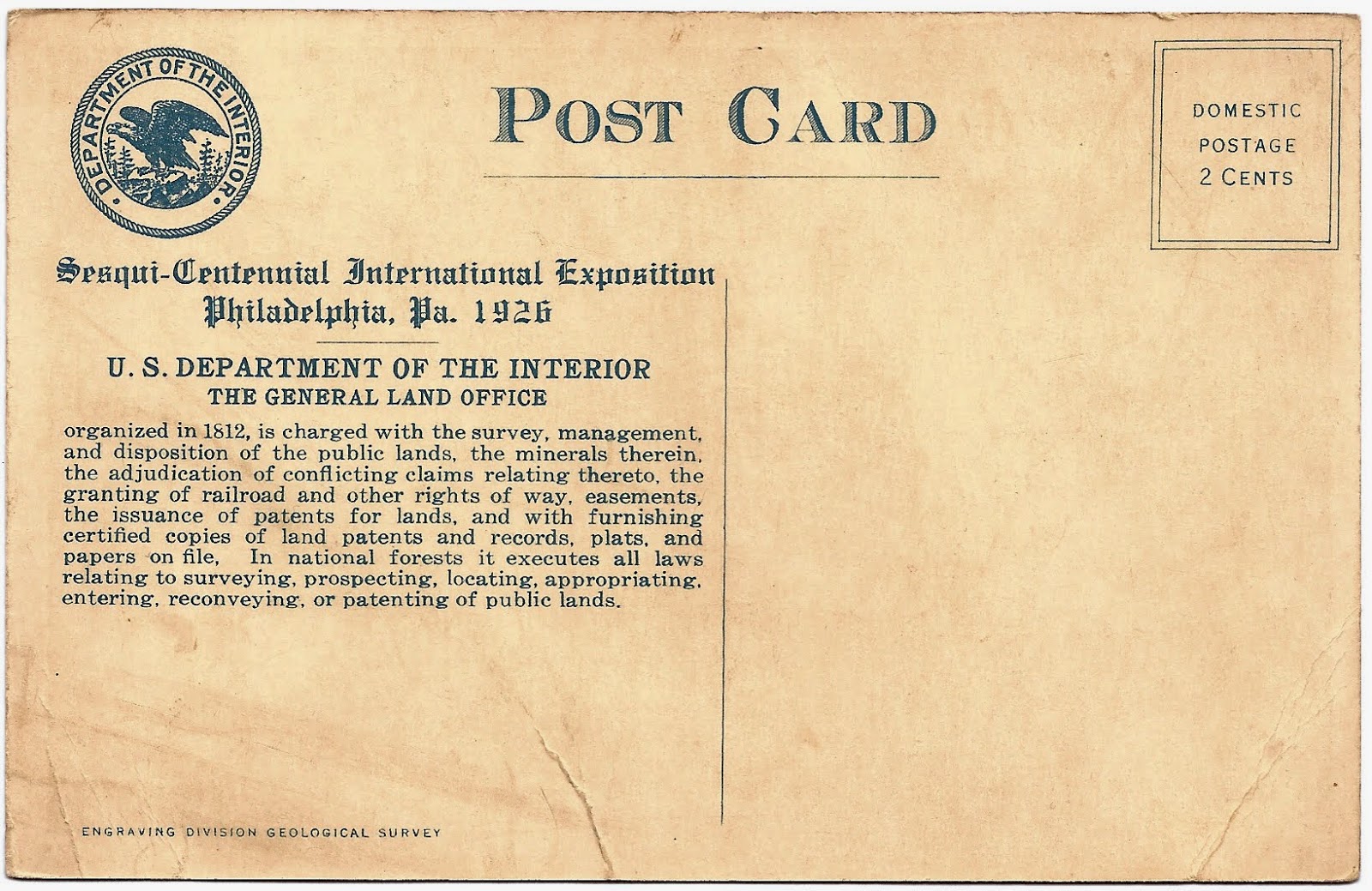
What’s Happening in 1926?

Why, it’s the Sesquicentennial International Exposition!

The exposition was a bust, going bankrupt in 1927.  But at least one Federal government agency got in on the celebration.  The General Land Office of the Department of the Interior issued this neat postcard:

I’m guessing the General Land Office had an exhibit in the ‘U.S. Gov – Transportation, Machinery, Mines & Metallurgy’ exhibit space near the south side of the exposition.

What was the General Land Office (GLO) and what did it do?  The GLO was formed in 1812 with the mission of selling federal lands to private individuals.  But the GLO was more than just a sales agency.  They first had to survey and subdivide federal lands into logical and easy to identify and register parcels.  Using the township & range system first used in 1785 by Thomas Hutchins to lay out the Seven Ranges area of eastern Ohio, the GLO conducted the largest land survey program in history, surveying, registering and selling billions of acres of public land stretching from the Ohio border to Washington State.

In 1946 the GLO was merged with other Department of the Interior agencies to for the Bureau of Land Management.  The BLM still conducts extensive land surveys, but certainly nothing like what took place during the heyday of the General Land Office in the late 1800s.

By the way, the popular saying ‘land office business’, which that indicates a flurry of business activity (“He’s doing a land-office business!”), popped up in the mid-1800s and refers to the often frenetic activity that surrounded local GLO offices as settlers scrambled to register and pay for their land claims.  Selling land was a booming business in the 1800’s, and nobody sold more of it than the GLO!

Brian

March 1st, 1861

On this day in 1861…

Who was David E. Twiggs?  Twiggs was a son of Georgia, born in Richmond County, and a veteran of the Mexican-American War, the Seminole War and the Blackhawk War.  In 1861 he was serving as a brevet Major General in the US Army and in command of the Army’s Department of Texas.  On 18 February 1861 Twiggs surrendered his entire command to the Confederates.  This included all military stores kept in the sanctuary of the old mission church in San Antonio – the Alamo.

A talented topographer and lieutenant colonel named Robert E. Lee happened to be part of Twigg’s command and was in San Antonio at the time of the surrender.  He is reported to have said, “So it has come so quickly to this?”

In fairness it looks like Twiggs repeatedly asked for guidance from the War Department as to what actions he should take if Texas seceded from the Union, but got no reply from his superior, General Winfield Scott.  Key Federal strongpoints and depots in Texas had been besieged by Confederate militias and Twigg’s forces were badly out-numbered at all locations.  General Twiggs apparently felt he had little choice but to negotiate an honorable surrender  He insisted on fair terms for the Union soldiers in his command.  They were afforded safe passage out of Texas and were allowed to retain their personal arms and unit colors.

Twiggs, a long serving soldier of great distinction, was apparently devastated by his dismissal from the US Army.  It’s not hard to imagine the shame he felt at seeing the notice of his dismissal published in the War Department’s General Orders for March 1st, 1861.  Although over 70 at the time, he accepted a commission as a major general in the Confederate Army.  But his military career was effectively over.  He died in Augusta, Georgia in the summer of 1862.

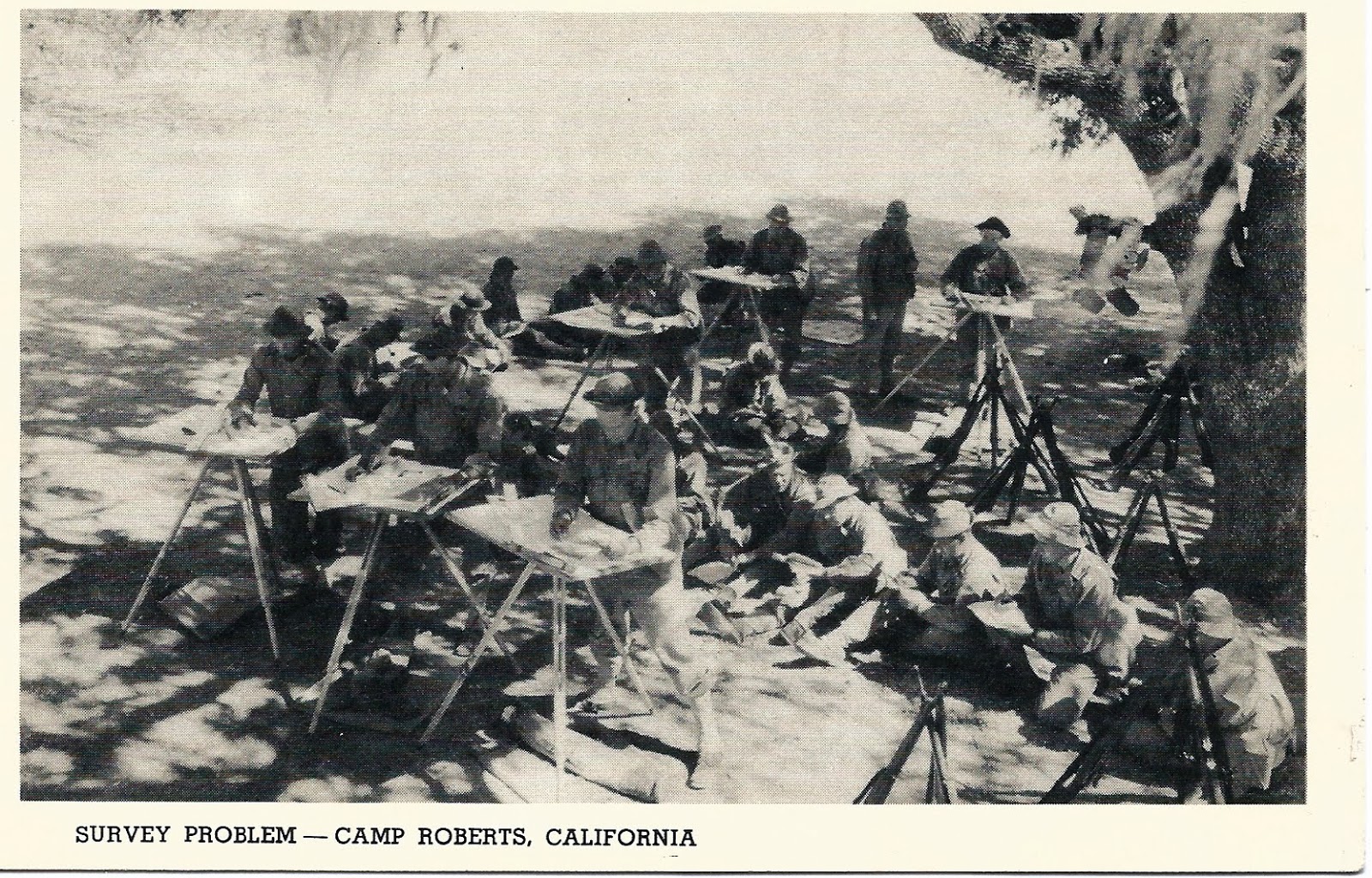
A Survey Problem

Or maybe not.  Here’s an interesting postcard I recently picked up –

It’s unused, so there’s no postmark on the back that I can use to nail down the date, but we can glean a few clues from the photo itself.  First, quite obviously it’s a WWII-era photo.  Probably early WWII because the rifles at stack arms are the M1903 Springfield.  Since Camp Roberts opened in March, 1941 and the US Army had effectively replaced the venerable ’03 Springfield with the new M1 Garand by early 1942 I’ll date this photo to mid-to-late 1941.

Next, I don’t think these Soldiers are ‘surveying’.  Since Camp Roberts was primarily an Infantry and Artillery training center my guess is that these are soldiers taking a class in Field Artillery plotting using plane tables.  Plane tables were a common item in Field Artillery battery TOEs, intended to be used as a field expedient plotting table.  I have one in my collection with the case stenciled ‘HQ FDC’ – Headquarters Fire Direction Center.  I have no idea which headquarters or which fire direction center, but clearly it was a piece of Field Artillery equipment (and identical to the plane tables used by Engineer survey units).  Another clue that this is a Field Artillery class is the use of large artillery plotting protractors.  You can just make them out on the plane tables in the foreground – large semi-circular protractors with a rotating plotting ruler mounted at the center.  Plus, there are no alidades visible, a key piece of equipment for any survey plane table work.

Yup, these are Field Artillery soldiers learning how to plot artillery fire.  But I will forgive the publisher’s gaffe because it’s still a neat picture of Army training in early WWII. The stacked rifles, the ammunition belts with canteens hanging from the tree, the Soldiers working the problems at the plotting boards while their classmates sit behind them studying their manuals.  I love how the plane tables are arrayed in an arc to best utilize the shade from the tree.  Looking at aerial photos of Camp Roberts on Google I’m guessing these guys found one of the very few shade trees available in this part of California.

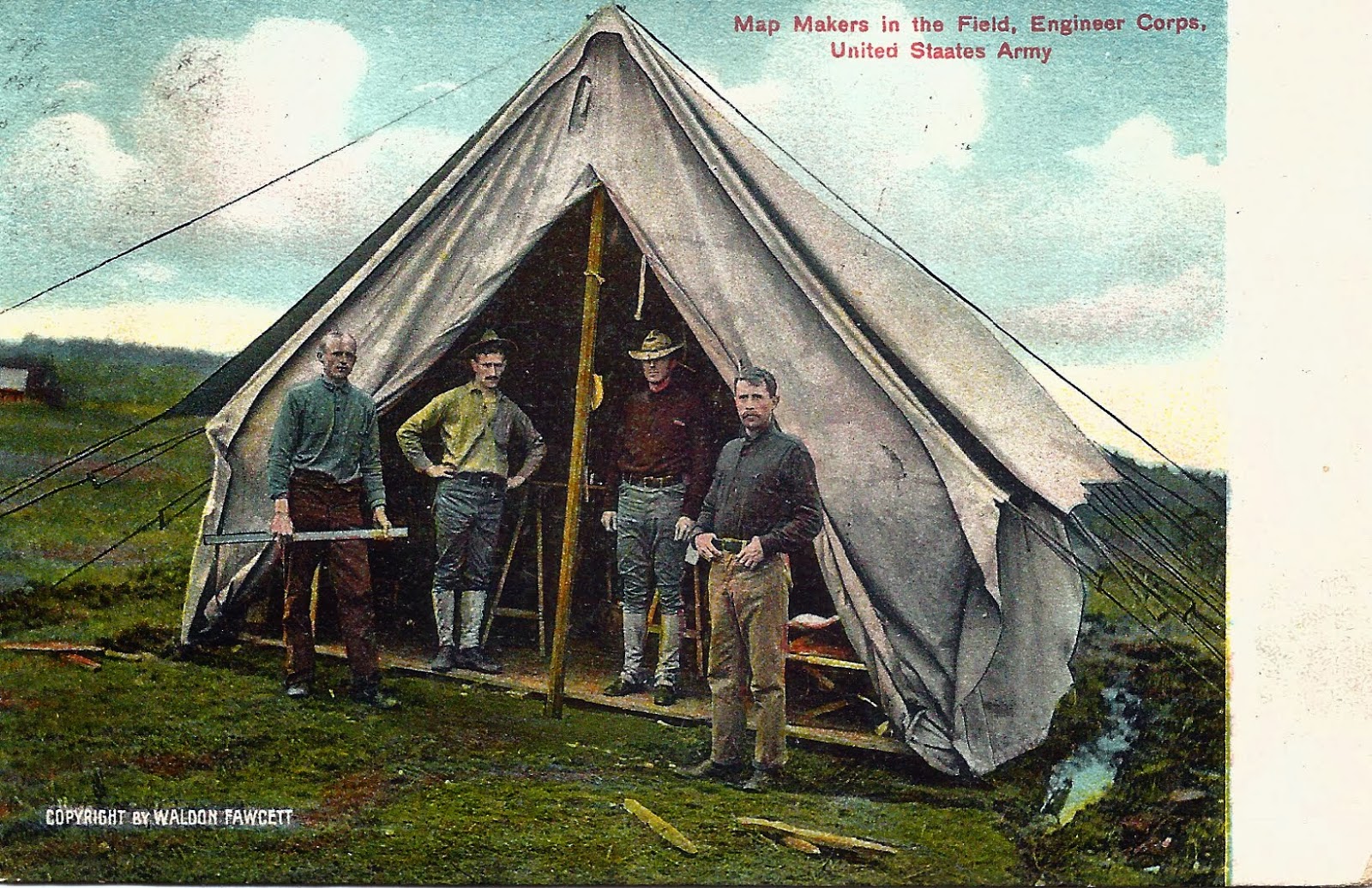
Send Out The Map Makers!

It’s 1908.  The Regimental Commander says “Hitch up the mules, we’re going on maneuvers!”

The Adjutant asks “Where, sir?”

The Commander points off to the horizon, “Why, out there of course!”

The Adjutant turns to the Regimental Engineer and asks, “Do we have any maps of ‘out there’?”

The Engineer says, “No, but we soon will!”

The Engineer turns to his assistant and says, “Send out the map makers!” And so it was!

GP Medium tent, duckboard flooring, folding cots, trenches to divert the rainwater and mud everywhere. Looks a lot like the 1st Cav Warfighter, Fort Hood, 1997.
If these guys are west of Yadkin Road without TA-50 there’ll be hell to pay! (Hat tip to old Fort Bragg hands.)
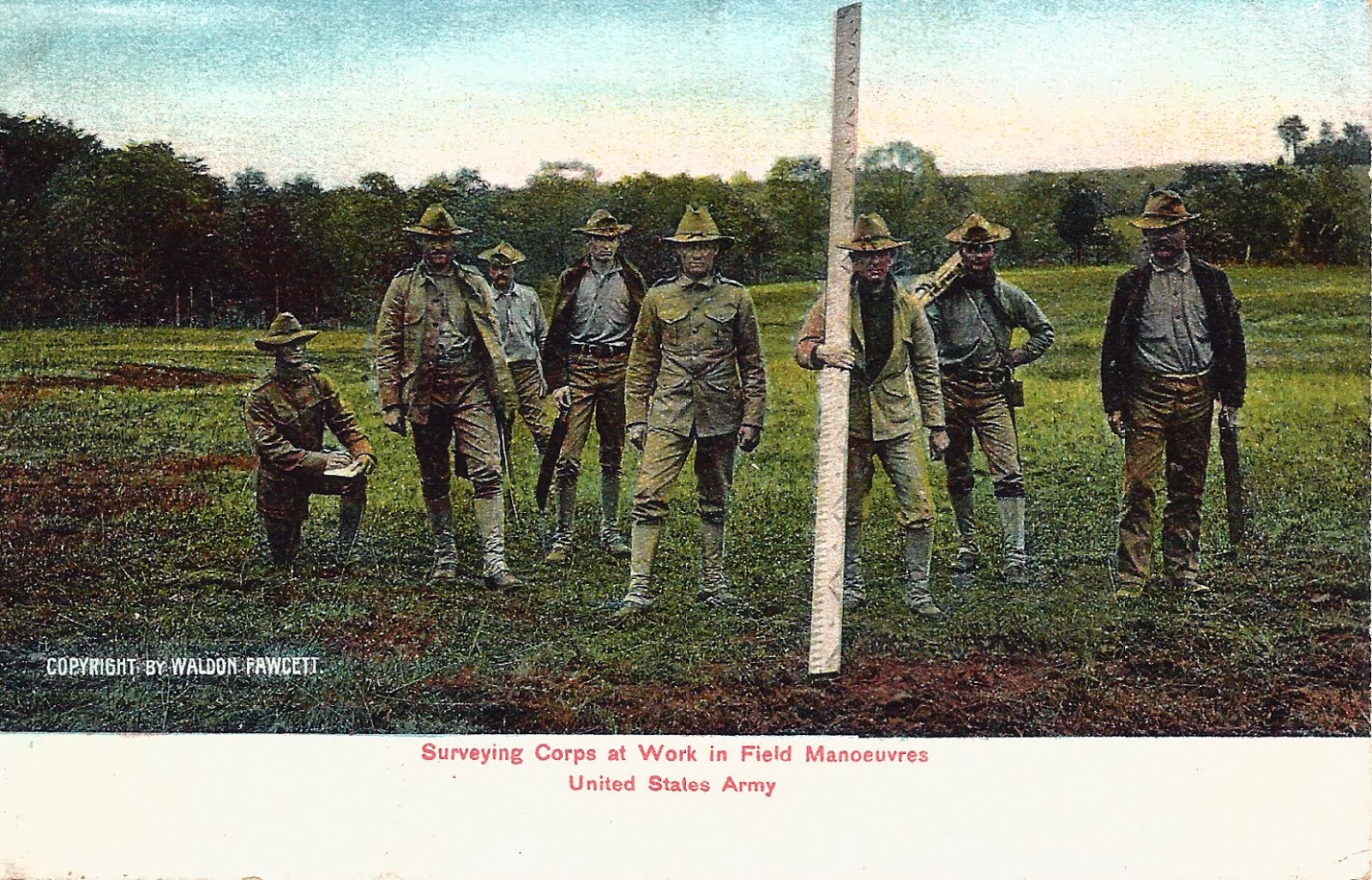
“Are you making fun of our big stick?”
I can’t say for sure where these photos were taken.  Two of the cards were postmarked at Fort Leavenworth so it’s possible the photos document classes taught as part of the Army Service Schools at Fort Leavenworth.  The Engineer portion of these courses included heavy emphasis on field survey and sketching.

The photographer, Waldon Fawcett, did a lot of photography for the US government right after the turn of the 20th century.  The Library of Congress has a number of his photos available online.  The fellow certainly was prolific – he seems to have captured a lot of governmental agencies at work during the Theodore Roosevelt administration, including Teddy himself.  It is possible that Fawcett was contracted to document the activities of the Fort Leavenworth schools and made postcards from some of the photos.

Someone was sweet on Miss Anna Williams.  Two of the cards were addressed to her. Her sweetheart must have decided that sending her pictures of muddy soldiers holding big sticks was the perfect way to win her heart. 2b3db-scan-014

Enjoy!

– Brian