Terrain Analysis

Last week I stumbled across this gem on YouTube –

It is a slightly dry film put out by the US Geological Survey in 1955 showing the modern (for the time) processes developed for natural resource analysis using aerial photography.

The guy narrating it sounds about as excited by his work as a dry goods salesman discussing the newest laundry soap.  Zzzzzzzzz…

But once past the dry narration I was interested by the methods demonstrated for geological, hydrological, soils and forestry analysis.  What struck me was that these were the precise methods we were taught at the Defense Mapping School as late as the early 1990s.  These photo analysis processes formed the basis for what we called Terrain Analysis, and in fact my job title for much of my Army career was Terrain Analysis Technician (MOS 215D).

This film approaches each type of analysis as an independent process – an end in itself.  We carried the analysis to the next level and merged the output from each of these four disciplines, mixed in some military-specific data like vehicle off-road capabilities, tossed in some road network analysis, some urban analysis and a pinch of weapon systems analysis and produced what we called a military terrain analysis.  Our products were usually delivered in the form of map overlays known as a combined obstacle study.  The process was very labor intensive and usually tightly focused on specific geographic areas like the Fulda Gap in Germany or the Koksan Bowl in Korea, natural movement corridors that had been used by armies for centuries.

Soldiers going into the Army’s Terrain Analysis field received extensive training in field identification methods like geological and soils analysis, hydrological analysis and route engineering studies.  They were taught to observe, test and measure in the field using a variety of hands-on methods.  Next they moved to the classroom and were taught advanced aerial photo analysis techniques and applied their field knowledge to what they saw in the photos.  It was hours and hours of peering at photos through stereoscopes, analyzing texture, tone and pattens to develop a detailed analysis of the terrain and it’s impacts on military operations.

Computers have taken on the burden of much of this analysis, and today you can feed a digital image into a sophisticated image analysis package like ERDAS Imagine and have it analyze huge swaths of territory in a small fraction of the time it took using the old manual methods shown in the film.  Still, it is fun to see how things were done in the good old days when men were men, hardhats were made out of aluminum and the science of aerial photo analysis found new applications in the civilian and military worlds.

Neatness Counts

Earlier we discussed the use of field notebooks and the lost art of field note taking.  I fear that neat, disciplined and structured field note taking is a lost art in the today’s world of texting, instant messaging, and email.  Even in the engineering, surveying and topographic field (where I work) the use of field notebooks appears to have been brushed aside by smartphones, laptop computers, data collectors and the assorted electronic bric-a-brac that has come to dominate the field.  And yet – and yet – all this powerful technology still leaves us with critical information gaps.  The problem is not so much that people aren’t writing stuff down, it is that they are writing it down in formats that are so very disjointed, disconnected and perishable.  An email here, a quick scribble on a random notepad there.  It gets lost or never gets integrated into the project file.  Months or years down the line engineers and maintenance personnel are left to wonder just where something was placed or how it was constructed because the story of that project was not properly documented.

Now, I’m not implying that the use of field notebooks will solve all of these problems.  Field notebooks are not a panacea for lousy project management.  My point is really that disciplined and structured note taking should be viewed as a key skill – and a requirement – for surveyors, engineers, topographers and other key staff.  Of course the ideal place to write all this down is in a field notebook, a field notebook that gets turned over to the organization, copied, indexed and integrated into a document management system at the completion of the project.

Neat, disciplined, complete and structured note taking.  Just what does that mean?

The disciplined and complete parts are easy.  Notes need to be made on any issue, topic, observation or discussion that directly impacts a project.  It is really nothing more than getting in the habit.  Get in the habit of having your notebook with you and writing stuff down.  Complete means get it all down.  Think of each record you create in the notebook as a miniature story – it needs to have a beginning, a middle and and end.  What you observed, when and where you observed it, what was important about it, who was there, what was agreed to, what conclusions were reached and, if necessary, sketches or diagrams that are key to the issue at hand.  Make it a complete story!

Neat and structured are two somewhat subjective concepts.  Everyone has their own style of organization and handwriting.  The important thing is to make it neat, legible and logical in structure.  Always remember that the intent is to make it easy for you and others in your organization to reference in the future.  How far into the future?  I routinely reference survey records for the airport I work at that are 60+ years old.  The neatness and structure (and completeness) of those records allow me to rely on them for locating structures and utilities that were abandoned and forgotten about decades ago.

I can only offer suggestions for the concepts of neatness and structure.  As I mentioned in my earlier post, field note taking used to be a topic taught in all beginning surveying and civil engineering courses.  Colleges, universities, government agencies (like the USGS and the USC&GS) and even individual companies used to have their own field note format requirements.  Some agencies, like the US Army Corps of Engineers, would even have entire bound books printed with pre-formatted pages.

A few agencies still provide specific field note standards.  Surprisingly, most are state departments of transportation (DOT).  For example, the Oregon DOT, provides specific guidance for field note structure.  Their Survey Field Note Standards (October 2006) provides very specific field note examples.  The same for the Montana DOT.  Their Survey Manual provides a chapter on sample notes that contractors are expected to follow.

But since this is my blog and I love old stuff, particularly old stuff that still has relevance, we’re going to take a trip back to the 1950s.  A time when cars had carburetors, space travel was the stuff of science fiction and real men did surveys with optical theodolites and steel measuring tapes, and wrote everything down in hard bound notebooks.  A couple of professors at the University of Missouri put together a course in introductory surveying and field measuring.  A large part of the class involved proper field note recording.  This course was to serve as the foundation for all surveying and civil engineering instruction to come, so the instructors needed to make sure the students got started on the right foot with disciplined, accurate, structured and comprehensive field data recording.  The two professors, Clarence Bardsley and Ernest Carlton put together a gem of a book titled ‘Surveyors Field Note Forms’.

Bardsley & Carlton, Surveyor’s Field
Note Forms (3rd Ed.)

The book opens with a treatise on the importance of field notes and the necessity of being an accurate, error free, neat and complete note taker.

“Allow no items for the memory; all facts should be on the record.”


“A good surveyor takes pride in the appearance of his notes.  A neat-appearing, well arranged set of field notes commands confidence and builds prestige in the surveyor.”


“Field notes should be clear and convey only one possibly correct interpretation.  Descriptions and narrative matter should be in acceptable English.  Sketches should be drawn to approximate, or convenient, scales.  All numerals indicating distances, angles, or elevation should be carefully formed.  Particular care should be exercised in obtaining a logical order and sequence of all notes, for they should be absolutely clear and understandable to the student, other surveyors, computers*, or draftsmen.”


The book then goes on to provide specific examples of problems and how the field notes should be formatted (click on any image to open it full-size):

Length of Pace Measurement

It was once common practice for surveyors to regularly measure and record their pace count over various types of terrain (flat, hilly, uphill, downhill, etc.).  Before accurate handheld measurement devices like GPS surveyors used pace count to do help them with tasks like finding property corner stakes or do rough fence line measurements.

Correcting for Horizontal Slope

Don’t you just love the name ‘Trachoma Hospital?

Using Rough Triangulation to Determine Distance

Although the equipment has improved, surveyors and engineers still use the principal of triangulation to determine inaccessible distances.

Sewer Stake-out

Construction stake-out, whether for sewers, buildings or roads, is still bread-and-butter work for surveyors.

Use of the Grade Rod

Field notes are for more than writing down numbers.  Often the engineer or surveyor needs to write down a description of how a particular piece of equipment was used, or a methodology that might need clarification.

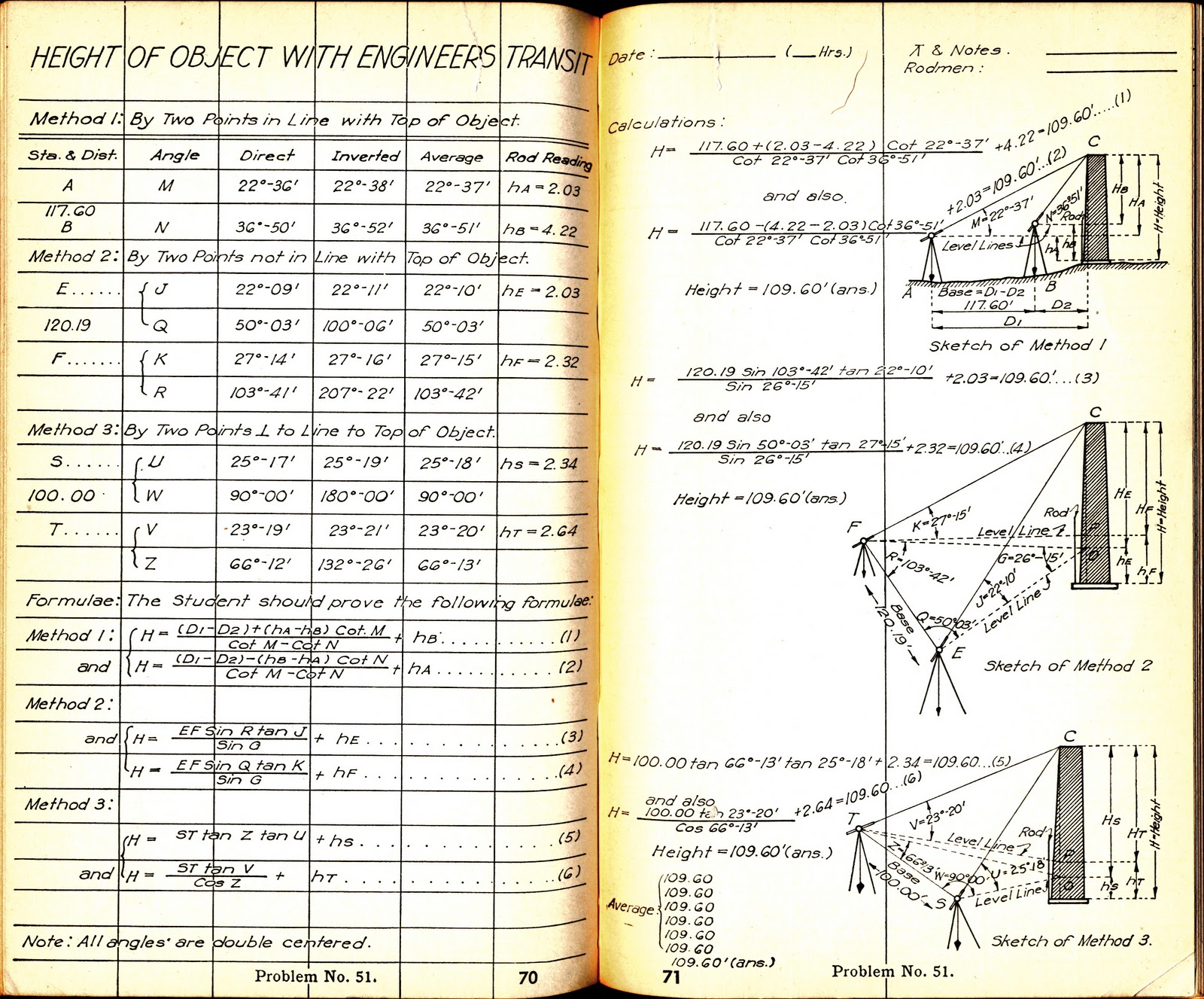
Height of Object

Again, the equipment may have changed, but the procedure is still the same.

Determining Azimuth From True North

Using solar or star shots is still an accepted practice for determining the relationship to true north.

The point of the above is not really what is on the page as much as it is the legibility, accuracy and completeness of the data.  One hundred years from now, when Microsoft .pst files are lost to eternity, digital CAD files can’t be opened and survey data collector files are corrupted beyond recall someone will still be able to pull a notebook like this one off the shelf, open it and clearly understand what the author wrote and was trying to convey.

Neatness does count.

As I was wrapping up this blog posting I asked Roberta (5th Grade Teacher of the Millennium) if kids in grade school still get penmanship lessons.  I was disappointed but not surprised to hear that, in her school system at least, penmanship has been sacrificed on the altar of computer skills.  Apparently the school system feels that there is not enough time to teach and practice penmanship, and since kid are all wired up to computers these days the time ‘wasted’ on penmanship is better put to teaching computer and ‘keyboarding’ skills.  How sad…

– Brian

(*Note – In the 1950s the term ‘computer’ meant something completely different.  Back then a ‘computer’ was an individual who was responsible for doing final computations against the surveyor’s field notes and applying statistical methods to determine the accuracy of the survey results.)

The Wilderness Route Finder

I grew up reading – devouring, really – the works of two great outdoor writers.  One was Brad Angier and the other was Calvin Rutstrum.  These two adventurers had been living the ‘back to nature’ lifestyle long before the backpacking craze hit America in the 1960s.  Both were prolific writers, turning out books and papers that extolled the wilderness lifestyle.  Angier’s works were more philosophic – he fancied himself a modern day Thoreau and his books reflected that outlook.  Rutstrum, on the other hand, didn’t just live the wilderness lifestyle, he actually worked in and made a living from the wilderness, primarily through guiding.  Rutstrum’s advice was always more down to earth, more practical.

Some of Rutstrum’s advice would cause modern day enviroweenies to fall over in a dead faint. For example, to deal with the biting insects that invariably got into your tent when camping in the north country Rutstrum recommended just tossing a DDT ‘bomb’ (spray canister) into the tent, zipping it up and letting the insecticide do its job.  Go off and do your chores and when you come back you’ll have a bug-free tent to sleep peacefully in.  Keep in mind, however, that Rustrum’s books were written from the late 1940s through the 1970s, so some procedures and ‘best practices’ are now out-dated and in many cases downright illegal.  Regardless, his books like ‘New Way of the Wilderness’ and ‘Paradise Below Zero’ are still considered classics of outdoor literature.

Another gem that Rutstrum wrote is ‘The Wilderness Route Finder’.

My copy, purchased in the late1970s and well
thumbed

I first came across this book over 30 years ago and read it cover to cover multiple times.  I believe it is the first broad application land navigation work written for the general public.  (The Army land navigation field manual, FM 21-26, pre-dates this work by several decades.  While an excellent work is targeted at military users.)  Rutstrum approached land navigation the way he approached so many things related to the outdoors – use what works.  He presents a broad range of techniques and discusses use of a number of pieces of equipment  that can assist in navigating the high latitudes where the magnetic compass becomes unreliable due to declination issues and local magnetism.

Obviously this book was written before GPS was even a gleam in the eye of senior military commanders, and many of the pieces of equipment Rutstrum discusses are out dated or simply not available anymore.  For example, cruiser compasses have not been made for decades and have now entered the status of collector’s item.  However, some of the techniques he discusses, while at first glance seemingly archaic in the world of cell phones, wireless internet and GPS, are still valid and those serious about land navigation ought to give them a try.  For example, the concept of using a marine sextant to determine latitude is quite valid, and quality used sextants are available today for less than $400.  Equip one with a bubble horizon and bring along a quality quartz watch and you could even do reasonably accurate longitude determination.  Think of it as an exercise in confidence building.

The reader should be aware that Rutstrum wrote this book specifically for those navigating in the far north regions of the US and Canada.   There is little in this book about desert or tropical environments.  Rutstrum was also a man of his time and wrote like it.  Many of the explanations are a little wordy and personal pronouns are few and far between.  Keeping in mind these shortcomings, the book is still an undisputed classic and belongs on the shelf of anyone serious about learning land navigation.

– Brian

Field Notebooks

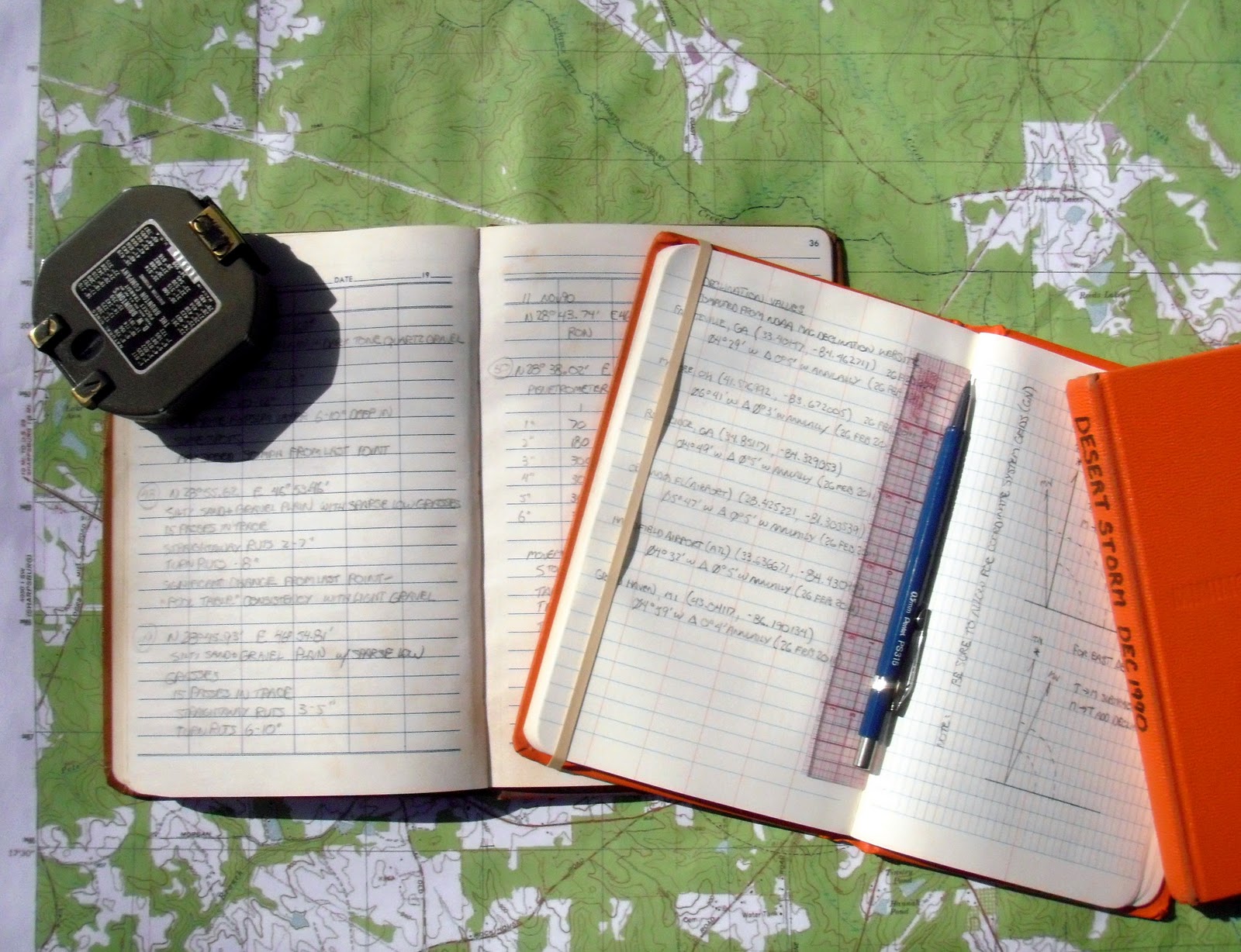
Does anyone use field notebooks anymore?

In the olden days (like, up until the 1980s) field notebooks were a staple of the surveying, engineering, geology and natural sciences disciplines.  If you did any field work it got recorded for posterity in a field notebook.  Taking and maintaining field notes was not just an art, it was often a legal requirement, particularly in the surveying field; the entries that surveyors made in their field notebooks constituted the legal record of a survey and those notebooks often were turned in at the completion of a project to become part of the permanent record.

Field note taking and recording was usually part of the early coursework for beginning engineering & surveying students, and you were graded on the completeness, legibility and accuracy of your note taking.  Pencil only!  Erasures not allowed!  Mistakes had to be lined through and corrected notations added.  Our geology field classes stressed accurate structural and stratigraphic mapping along with proper representations of rock types and strike and dip measurements.  It was common during field classes for our professors to pull out an old weatherbeaten field notebook and refer to notes they had taken years before on the rock formations we were studying.

Virtually all of the big name engineering and survey supply companies sold field notebooks.  They were all pretty much the same – a hard bound book filled with blank lined pages (or alternating lined and graph) about 5″ x 7″.  The paper was 50% cotton rag content and usually treated to ensure archival stability and prevent wrinkling  from high humidity.  Most books included tables of conversion formulas, trig functions, curve tables, etc. in the last few tables; things now easily handled by a simple scientific calculator.  My suspicion is that there were only a few companies that actually produced these books and just did job orders for the big manufacturers.  There was a slight difference in quality from manufacturer to manufacturer, and the K & E and Post field books I’ve got in my collection are clearly a step above the average field book with sturdier covers and radiused page corners.

The US Army even got in on the act, and produced two styles of field books they classified as ‘forms’  One, the DA Form 4446 – Level, Transit and General Survey Record Book was laid out like a generic notebook.  The other, DA Form 4196 – Horizontal Distance Book, was laid out specifically for recording traverses.  Both included a handy tear-out address label so that if found all someone had to do was tape the label to the outside of the book and drop it in a mailbox and the Army would pay the postage to get it back to its owner.  To this day I kick myself for not picking up more of these manuals when our Army surveyors abandoned them in favor of pre-printed recording forms.  They had boxes of them laying around new in the shrink wrap and I’m sure most went into the dumpster when they got tired of looking at them.

Thankfully, field notebooks are still available from engineering and forestry supply houses. Still in the same format and the same construction.  I guess when you hit on a winning formula there’s no need to change.

But like so much in life, electronics got in the way.  With the arrival of total survey stations (theodolites), GPS-linked data collectors and computers running surveying and engineering-specific software the need for writing down project notes in a field notebook quickly disappeared.  While surveyors still use field notebooks to record things like the height of instrument or the serial number of the GPS receiver they are using on a particular project, the field notebook is no longer considered an indispensable item.

For much of my Army career I used field notebooks extensively, a practice carried over from my geology fieldwork days.  I was a sloppy note taker (see above), but I managed to get stuff into a logical and readable format.  Over the years I filled about half a dozen field notebooks with data collected on various projects in different parts of the world.  As I neared retirement I got caught up in the digital craze and abandoned notebooks for whatever was hot at that moment.  I’ve owned or used Pocket PCs, BlackBerrys, smart phones, iPhones, laptops, digital notebooks, you name it.  I’ve stored my notes in Borland Sidekick (anyone remember that piece of malware?), Windows Notes, Lotus Notes, Outlook, Outlook Express, iPhone Notes, MS Word, Wordstar, PC-Write, Open Office, and Google Docs.  Guess what?  Just about everything I stored in digital format is gone, gone, gone – unless I made a paper copy as back-up.  Roughly 10 years of meeting notes, field notes, observations, discussions, instructions from supervisors and directions to subordinates, everything gone.  Not because of some catastrophic event, but lost simply to the march of time, the changes in technology and the inevitable degrading of the storage media.

How many of you still have 5 1/4″ or 3 1/2″ floppies sitting around you can no longer read simply because you don’t have a device capable of reading them?  Can your new DVD drive read that CD you burned back in 1999?  Ever wonder why TV shows shot in the 1970s and 80s look so funky?  It’s not because of the bad hairdos or polyester leisure suits, but because so many of them were shot on videotape and the tape is starting to deteriorate.

Today the only way I can resurrect the record of my military career is through the written word put down on paper.  Thankfully I saved just about everything. I can’t tell you the meetings I had in 2005, but I can tell you in some fair detail about the meetings I attended in 1985. In 2005 I trusted digital technology to store my data. In 1985 I trusted a notebook and a pencil.

About a year ago I realized I was missing key notes on some fairly heated meetings we had held with one of our business units at work.  I knew I had probably written my meeting notes and observations in a series of emails to my boss, but for the life of me I couldn’t find the emails.  After about two days of searching on my computer and on our shared drives I remembered that I had done an email backup and clean-out about six months earlier and that my backed up files were on a USB drive – a drive I knew I had misplaced a few weeks before!  At that point I resolved to start writing things down and decided to start using field notebooks again.

As I’ve gotten back into the process of writing things down archivally I’ve been surprised at how my seemingly random scribblings begin to come together to tell the tale of the projects, events or items of interest that impact my life.  I can flip through the pages of my notebook and clearly view the progress of projects and issues I’m tracking.  I can go back to meetings held months ago to remind myself precisely what was said and agreed to. When an engineer has a question about the invert of a pipe we measured three months ago I can show him my original field notes. Sure, all of this information can be stored digitally (and most of it is), but my experience shows that I can’t put much stock in that digital data being available five years from now. In five years I’m pretty sure my notebook will be sitting on my shelf ready to be opened and referenced.

If it’s important, write it down on paper!


Brian

A Detached Fascination

By any measure yesterday’s earthquake in Japan was a horrific human catastrophe.  It’ll take weeks, maybe months, to tally up the loss of human life.  The reconstruction of Japan will take decades.  I have no doubt that this earthquake and its aftermath will be viewed as seminal event in Japanese history.  From this point forward the Japanese as a people, a society and a nation will never be the same.  My heart goes out to them.

From the perspective of a geoscientist, however, this earthquake is an absolutely captivating event.  I’m following the emerging technical reports with almost morbid fascination.  Reports now are that the earthquake intensity may be upgraded from magnitude 8.9 to magnitude 9.1, based on post-event analysis.   There was an almost 60 foot displacement along the crustal plate boundaries at the epicenter.  The quake shifted Honshu, the main island of Japan, by over 8 feet.  The earth was knocked off it’s axis by about 10 inches!

And today, over 24 hours after the event, the area is still shaking.  Japan experienced a 5.8 magnitude aftershock in the same area just this morning.

If this event, like Katrina, teaches us anything it is that the earth will have her way with us and man can only do so much to anticipate and prepare.  We are all just along for the ride on this big blue marble.

Happy Birthday USGS

Missed it by a day, but Happy Birthday to the US Geological Survey!

The USGS was established on 3 March 1879, almost as an afterthought in a Federal budget submittal. It’s stated mission was “classification of the public lands, and examination of the geological structure, mineral resources, and products of the national domain.”

The first part of that mission, “classification of the public lands,” was what drove a lot of the USGS’s early efforts.  The US had acquired a lot of land as the result of the Louisiana Purchase and the Mexican War, but we didn’t have a very good picture of just what it was we had gotten our hands on.  The USGS launched a standardized mapping effort that continues to this day, and will never really be completed.  Mapping the United States is like painting the Golden Gate Bridge, as soon as you finish at one end it’s time to go back and start again at the other.

I’m hard pressed to name another federal agency that has done so much good work for both the nation as a whole and its citizens.

So here’s the the US Geological Survey. Happy one hundred and thirty second birthday!

Measuring Things

US Coast & Geodetic Survey leveling party working in Atlanta, 1927

In the olden days, like before GPS, before you could make an accurate map real men had to go out and measure things.  This ‘measuring’ was called surveying, and it involved the extremely precise and accurate determination of the horizontal and/or vertical location of points on the ground known as survey control.  This survey control establishes the accurate framework upon which a map is built.  Horizontal measuring was called triangulation. Vertical measuring was called leveling.

 
The picture above comes from the US Coast & Geodetic Survey 1927 Seasons Report prepared by Captain E. O. Heaton (USC&GS).  It shows a topographic leveling party at work in Atlanta.  If anyone can figure out where in Atlanta these guys are working I’d love to know!
A few things to note.  The fellow holding the umbrella is most likely a black local laborer hired to help the party haul equipment and provide general assistance.  The umbrella he’s holding isn’t to keep the surveyor from getting sunburned – it is to protect the instrument from direct sun and prevent glare when sighting through it.  To ensure accuracy survey parties often used umbrellas to shade their instruments and stabilize temperatures.
The fellow squatting is a surveyor who is acting as the recorder.  He is writing down the readings being called out by the surveyor looking through the instrument.  The recorder’s job was extremely important because he didn’t just write down what the surveyor called out, he would do on-the-fly quality control checks on the values the surveyor gave him to ensure they were staying within the accuracy standards established for that particular survey.  If the recorder makes a single mistake, such as not catching an error in the surveyor’s observations or by writing something down wrong (like inadvertently transposing a number or putting a decimal point in the wrong place) he could lose an entire day’s work.  In my experience you wanted your  most meticulous guy and your best mathematician doing this job – perfectionists made good recorders.  The recorder is writing his notes down in a bound hardback book known as a survey field notebook.  That notebook would be turned in to the USC&GS at the end of the project and go on to become a part of the legal record of the survey.  I have no doubt that very notebook still exists in the archives of the USC&GS now held by the National Oceanic and Atmospheric Administration.  I’d love to take a peek at it!

(The job of recorder is one of those skills that has been replaced by computers.  Today’s surveying instruments now automatically store the readings and calculate values internally.  The computer integrated into the survey level lets the surveyor know via a digital display if the readings are within the specifications set for the job.  It’s called digital leveling.)

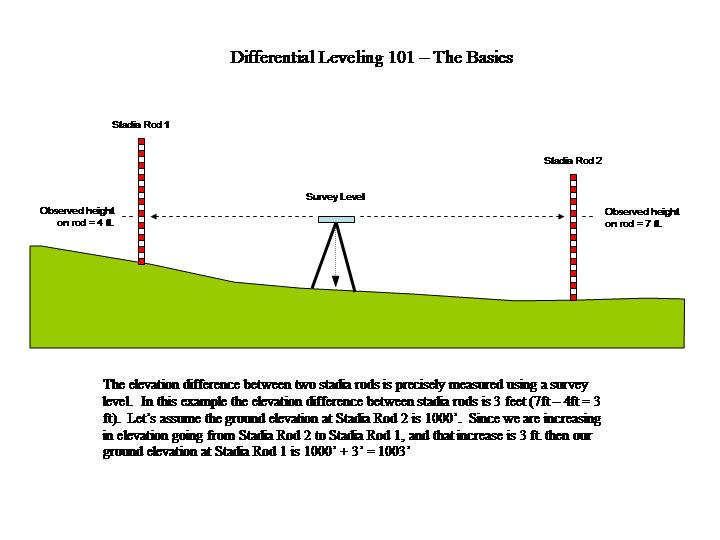
But what is the surveyor looking at?  Well, there are two people missing from this photo that make up the leveling party.  The surveyor is looking through the survey level at a stadia rod being held by another party member known as a rod man.  A stadia rod is a long pole marked off in feet and inches.  Behind the surveyor is another rod man with another stadia pole (the location of the stadia poles is determined by the survey party chief and is based mainly on topography and the ability to see both poles from where the survey level is set up).  The surveyor looks though the level and calls out the elevation mark he sees on the first stadia rod.  He then reverses direction and calls out the elevation he views on the second stadia rod.  The difference in numeric values he views on the two stadia poles is the difference in elevation between them:
Click on the image to open full size
Additionally, if this is a simple differential leveling job (and I think it is based on the type of level being used), there is another crew of chain men measuring the distance between the two stadia rods.  In 1927 this would have been done using steel survey tapes or chains.
Leveling is slow, tedious and physically demanding work.  There were no old farts out working on leveling parties except perhaps as party chiefs.  The rod men and the chain men were constantly moving, carrying the survey forward.  The instrument man and the recorder were responsible for moving and setting up the level in a new location, and the party chief was moving between all members of the survey party and scouting ahead for new setup locations.
Their work was absolutely critical, though.  The meticulous work of the surveyors of the US Coast & Geodetic Survey and the US Geological Survey created the accurate spatial framework that this countries maps and charts continue to be built upon.
But that’s not the end of this story!  I got interested in this picture for a particular reason.  The vertical survey control for the airport I work at was established by this particular USC&GS survey project.  I would like to think that it was these three unnamed gentlemen who, sometime in 1927 or 28, ran their traverse down into College Park, GA and set the single elevation benchmark that became the origin point for all vertical survey work done at the airport until the advent of GPS-based survey in the late 1990s.
Brian

In Praise of the Old Topographer

Progress is good.

Without progress we wouldn’t have a lot of great things like:

Penicillin
Computers
Electronic ignition
Cell phones
Frozen pizza

Few could argue that these developments have significantly enriched our lives or made them easier.  (Have an issue with electronic ignition being on the list?  Ever hand crank a car to get it started?)

But too many people equate change with progress.  If you change something, particularly if you change something that few people really understand, you can claim progress and nobody really stops to say, “Uh, I don’t think so”.

So it is today with my ‘profession’ – Geospatial Information Services (GIS).

I put the term profession in quotes when using it in conjunction with GIS, because I’m not really sure GIS is a profession.  It certainly is a job – there are thousands of people working GIS jobs around the world, but in my opinion it’s not really a profession, not yet anyway.

And the story of GIS is the story of change without real progress.

Background.  I have been working in the mapping, survey and geographic analysis field almost continuously since 1980.  I watched as the US military, particularly the Army geospatial engineering field, transitioned from the old manual analysis and production methods to computer-based analysis and production.  When I started it was all hand drawn overlays and paper maps.  Today it is GIS software and web-based mapping services.  I have certainly seen change in my field – fundamental, earth shaking change.  I’m not so sure I’ve really seen a lot of progress.  In fact, I would claim we’ve actually moved backwards in our ability to provide clear analysis and decision support tools to our customers.  We have moved forward with change, yet backwards with progress.

How can that be?  Simple.  The GIS field has traded fundamental skills for computer application expertise,  and the lack of fundamental skills and the ability to do critical analysis makes the field a slave to the software.

Change without progress.

Go up to any GIS professional and ask him or her to describe their job.  They will stumble around trying to explain it to you and invariably the words ‘arcgis’, ‘computer’, ‘database’ and ‘web maps’ will leak out.  The GIS professionals today can not think about, describe or relate their jobs without first thinking about the computer application.  For far too many of them the computer application is their job.  Continue the line of questioning and ask them if they think they can continue to do their job effectively without their computers and GIS software, even for just a short period of time.  Again, most will say no – in their minds their ‘profession’ is inseparable from and defined by the software.

Ask a civil engineer to define his or her profession.  You won’t hear words like ‘autocad’ or ‘microstation’ slip out, yet AutoCAD and MicroStation are the two leading engineering design packages in use around the world.  Reason?  Civil engineers don’t define their profession in relation to software applications.  Civil engineers are educated and trained to solve complex issues using analytical skills.  I work every day with extremely competent civil engineers who plan and manage multi-million dollar projects, yet they don’t even know how to open up an AutoCAD drawing file on their desktop computer.  They were hired for their engineering and problem solving expertise.  Software applications are merely enabling technologies that allow them to work more efficiently.

Put the same question to a land surveyor.  You won’t hear terms like ‘terramodel’, ‘geomatics office’, or ‘civil3d’.  These are software packages that enable surveyors to do their jobs more effectively and efficiently, but they do not define the profession.  The survey profession is defined by a set of standards tied to analytical and problem solving skills.

In each of these cases the profession defined what it needed from the software and the vendors responded.  In the GIS field things evolved the other way.  In the beginning (way back in the 1970s), the term ‘GIS’ defined software, not a skill set (the original term GIS stood for ‘geographic information software’ and has only recently morphed into ‘geospatial information system’).  Other professions like Forestry, Geology and Geography started using GIS technology to better manage large amounts of data that had a spatial component – things like timber stands, mineral lease boundaries and census data.  The software was revolutionary, but it was an enabling technology and not an end in itself.  Because the software was used by a broad range of professions there was little standardization.

As the years progressed and GIS software matured, more and more individuals became captivated by the GIS concept.  I will admit, in addition to having powerful analytical capabilities GIS packages like ESRI’s ArcGIS are just plain fun to work with.  However, these applications do little to enforce standards.   Everybody gets to do what they want.  That’s not the software’s fault – it’s up to the GIS professional to apply recognized standards.  But before you can have standards you have to clearly define your profession, and if you can’t define your profession how can you define your standards?  It was as though GIS had no conceptual roots – a discipline born anew, without heritage or precedent.  And nobody wanted to take ownership.  So, heavy GIS software user self identified themselves as ‘professionals’ and happily motored along, defining themselves any way they wanted.  As a result the GIS profession has become a primordal soup of software users with varying skill sets.  Some are damned sharp, other’s have trouble finding the ArcGIS icon on their computer desktop.  Yet all get to claim the title of ‘GIS Professional’ because, well, nobody told ’em they can’t.*

I refuse to be defined by a software package.  I am better than that, and my employers didn’t hire me for my button pushing skills.  They hired me to solve complex problems and provide unique services no other group in the organization could provide.  If I can provide the answer by scribbling a few calculations on a notepad, great.  If I have to fire up high end GIS software to run a complex analysis, OK.  How I arrive at the solution is immaterial to my employer, they just want an accurate answer that conforms to the established standards of the disciplines I’m touching.

But if GIS is the software, what is the discipline?  What melds geography, geology, forestry, hydrology, landform analysis, civil and structural engineering, environmental science and surveying into a multi-discipline approach to problem solving?  What discipline applies the best approach to describing the land and the structures on it and features below it with accuracy and precision?  What discipline relates data using a multi-disciplinary approach to solve the unique and complex problems beyond the realm of other earth science and engineering disciplines?  That discipline doesn’t exist, you say?

Balderdash!

The discipline I describe has existed for over 150 years.  This discipline opened the American west to exploration and settlement, unlocked the vast natural resources of this country and helped fuel it’s rise to an economic world power, it charted America’s home waters for safe navigation, mapped vast expanses of Central and South America and even mapped the Moon to identify safe landing areas for our Apollo missions.  Most came to this discipline from other professions.  It drew in its share of civil engineers, geologists, surveyors and geographers.  It was once the leading career choice for the top graduates from West Point.  This discipline started to die out in the 1980s, with the rise of specialization and computerization, when we tried to replace broad experience with computer algorithms.  Yet it is a discipline that is still as relevant today as it was in the mid-1800s, perhaps even more so as our infrastructure, development, enviromental, and energy issues start to intersect in ways only spatially-based analysis can address.

This is the discipline of the old Topographer!  

A topographer of the old Coast & Geodetic Survey, conducting
what is essentially a geospatial analysis using a plane table survey set

By definition, a topographer is someone who precisely maps and describes a portion of the earth’s surface and the man made features on it.  That is about as elegant a description of what I do as any I’ve found.

So, don’t call me a GIS professional, analyst, manager, coordinator or anything else related to a software application.

Call me a Topographer!

– Brian
* I understand we have this thing called the GISP certification program.  In its current form it’s a joke.  What does it certify?  Other professions with established licensing standards, like the engineering and survey fields laugh at the GISP certification program.  How can you certify against something that doesn’t have standards?
Right Under My Nose The Whole Time

As many of you know, I’ve been scratching around for some time trying to dig up the origins of the Military Grid Reference System (MGRS). I recently became interested in it in light of the fact that the US Geological Survey and Department of Homeland Security have adopted MGRS as the grid standard for the continental US (they’re only 60 years late, but who’s counting!).

I had some old friends at Fort Bragg who are involved in the mapping & charting field root around and they came back with the opinion that development of MGRS was likely tied to NATO and NATO standard agreements (STANAGs as we used to call them). There is probably some truth to that, but there were still several pieces of the puzzle missing. One of those was just when the US Army adopted MGRS.

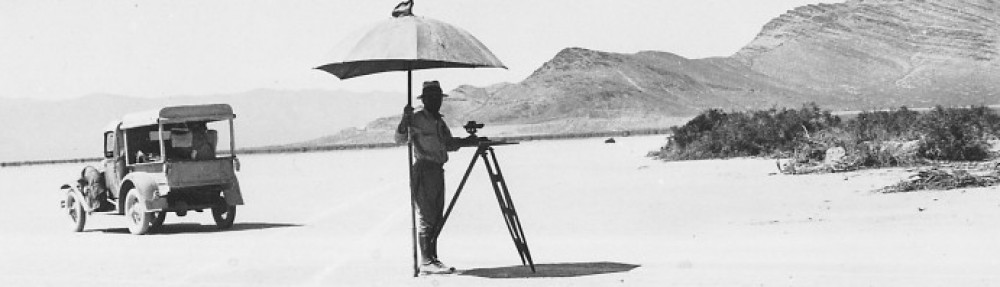
For the past several months I’ve been scouring eBay, purchasing early copies of US Army map reading and land navigation manuals. The first official, general issue map reading manual came out in 1938 (Basic Field Manual Volume 1, Chapter 5, Map and Aerial Photograph Reading) and was quickly followed by updates in 1941 and 1944 as FM 21-25.

Tucked away in the back of my 1944 copy of FM 21-25, Elementary Map and Aerial Photograph Reading were two changes that I never paid much attention to. ‘Changes’ in Army parlance were updates to manuals or other documents. The Army would publish a change in the form of an addendum and distribute it throughout the Army. It was the individual unit’s job to make sure all the changes were ‘posted’ (this usually meant you physically attached the change document to the base document by some means, like stapling). That’s how the military managed publication changes before this internet thingey came along.

Today I was giving this manual a close read and decided to pay attention to the change documents. To my surprise one of the changes (Change 2) was dated November 1950 and was summarized as follows:

“Principal changes are in methods of giving grid references. These changes are made to comply with AGAO-S 061.3 (28 Dec 49) CSGID-M, dated 29 December 1949, which establishes the MILITARY GRID REFERENCE SYSTEM as official for the Department of the Army”

So there you have it. The Army adopted MGRS in December 1949. Part of the mystery solved!

So now I know the why and the when. What’s still missing is the how.

MGRS is based on the Universal Transverse Mercator Grid (UTM), which was developed by the Army Map Service sometime right after WWII.  What I need to find now is the original description of UTM and MGRS, the document prepared by the Army Map Service describing how MGRS is calculated and constructed, and how it should be implemented.

My guess is that these founding documents are buried deep in the archives of the National Geospatial-Intelligence Agency (the descendant of the Army Map Service).

Anybody know someone at NGA who can spend a lunch hour digging around for this info?

– Brian

Inter-American Geodetic Survey

The Inter-American Geodetic Survey (IAGS) was one of those extremely successful, yet little known, US Army (and later, Dept. of Defense) programs established after WWII.

The IAGS was created specifically to assist Latin American countries in surveying and mapping their vast internal regions that were either poorly mapped or entirely unmapped. The IAGS was established in 1946 as part of the Army Map Service and was headquartered at Fort Clayton in the Panama Canal Zone. The Army Map Service set up a complete survey, cartographic and map reproduction school at Fort Clayton and over the next 30 years trained thousands of military and civilian personnel from most Latin American and Caribbean countries. Attendance at the IAGS school at Fort Clayton was seen as right of passage for many up and coming officers in Latin American militaries, and it was common to run across senior officers – colonels and generals – from South American countries who talked fondly of their time spent at Fort Clayton, taking surveying or cartographic classes (one infamous graduate of the IAGS schools just happens to be Panamanian dictator Manuel Noriega, who attended the cartographic school in the 1960s).

The IAGS didn’t just provide training.  It also provided the equipment and personnel to assist the participating countries in establishing their own self-sufficient mapping and surveying programs.  The goal was to provide the training, equipment and technical support but have the individual countries take over their own mapping efforts.

Now, I’m not going to pretend that the IAGS was all altruistic good-will on America’s part.  We learned the hard way during WWII that many Latin American countries were at best reluctant allies, at worst active sympathizers with the Nazi regime.  At the end of WWII the political systems in these countries ranged from shaky democracies to hard line dictatorships.  The US Government became concerned about the effects of political unrest and Communist influence in the region, and instituted a number of programs designed to bring Latin America firmly under American influence and to foster democratic principles and improve economic conditions.  The IAGS was just one of many programs created as part of this effort.  One extremely important benefit the IAGS provided back to the US was that we were able to get American personnel on the ground in these countries to make detailed evaluations of local conditions (after all, that’s what surveyors and cartographers do, right?) and we got maps that were created to US standards for vast areas of Central and South America.

According to all the accounts I’ve read and my own direct experience with the IAGS in Central and South America, the program was a great success. The goals of the IAGS were warmly embraced by most countries, who realized they utterly lacked the resources and training needed to map their own territories. IAGS liasion personnel were permanently assigned to each country, working out of the US embassies, and developed deep and lasting ties with government, military and business leaders.  IAGS personnel were very highly regarded in most countries, and I’ve heard more than one old-timer talk about how whenever they flew into a country to work and the local customs agents saw the distinctive IAGS logo on their luggage they were swiftly and courteously passed through customs without inspection or interrogation.

My introduction to the IAGS came when I attended the Defense Mapping School’s Mapping, Charting & Geodesy Officer’s Course at Fort Belvior, Virginia back in 1982.  By then the IAGS had been, or was in the process of transforming into, the Defense Mapping Agency International Division (I’m running on memory here, so please forgive any errors). However, the IAGS logo was visible throughout the building, and we received a short orientation brief on IAGS operations.  My next contact came in 1990 while working in Honduras as part of an airfield construction task force.  My team’s job was to conduct route reconnaissance and terrain evaluation of large sections of southern Honduras.  We made contact with the Honduran IAGS liaison officer, Emory Phlegar.  Emory was a long time IAGS hand who had ‘gone native’ – he married into Honduran society and seemed to know everyone and everything that was going on in that small, poor country.  He provided us a wealth of information and with a simple phone call opened a number of doors for us with the Honduran Instituto Goegrafico Nacional (National Geographic Institute).

Three years later I was stationed at Fort Clayton, Panama, and headed up the geographic analysis team supporting US Army South and US Southern Command.  This job put me in close and frequent contact with the last remnant of the IAGS in the old Canal Zone. Southern Command and the Defense Mapping Agency (DMA) ran a joint map warehouse on Albrook Air Force Station.  The Air Force took care of ordering, stocking and issuing standard US maps to all US military operating in Central and South America.  In the same building the Defense Mapping Agency ran a small but very interesting and critical ‘local products’ warehouse that received and stocked maps printed by the different countries who had been part of the IAGS.  By agreement, DMA received 100 copies of every map printed by the participating countries. Quite often these maps were the only representation of Central and South American land areas available to the US military, and we relied heavily on this map supply. In fact my unit acquired an early large format Xerox copier specifically to make copies of these maps for Army use so as not to draw down the limited stock kept by DMA.

Additionally, DMA continued to operate a topographic and survey instrument repair shop out of the building.  This was a one man show, employing an instrument repairman who fixed or calibrated any equipment that had been loaned to countries participating in the IAGS.  Much of the loaned equipment was simply too big to pack up and send back to Albrook to be worked on, so this lone repairman spent a lot of time on the road traveling from country to country repairing equipment.  Most of what he worked on was obsolete by US standards, but was still perfectly serviceable and suitable to the Latin American countries that couldn’t afford anything more modern. As such, his workshop at Albrook was a fascinating mix of spare parts bins and machine tools.  Since he dealt with a lot of obsolete equipment I’m sure he had the skills and equipment needed to fabricate any broken or worn part.

Unfortunately there is very little information about the IAGS on the web.  Not even Wikipedia has a dedicated page, and only catalogs indirect references to the agency. This is a shame, because the IAGS was a landmark cooperative effort that yielded enormous benefit for all countries involved, and its story needs to be out there for everyone to read. Somebody at the National Geospatial-Intelligence Agency (the successor to the Defense Mapping Agency) or the Corps of Engineers needs to write up a short history of the IAGS and its accomplishments while the participants are still around to tell their stories.

But for now it is You Tube to the rescue!  I found this film, part of the Army’s ‘Big Picture’ series, covering IAGS operations:

Enjoy!

Brian